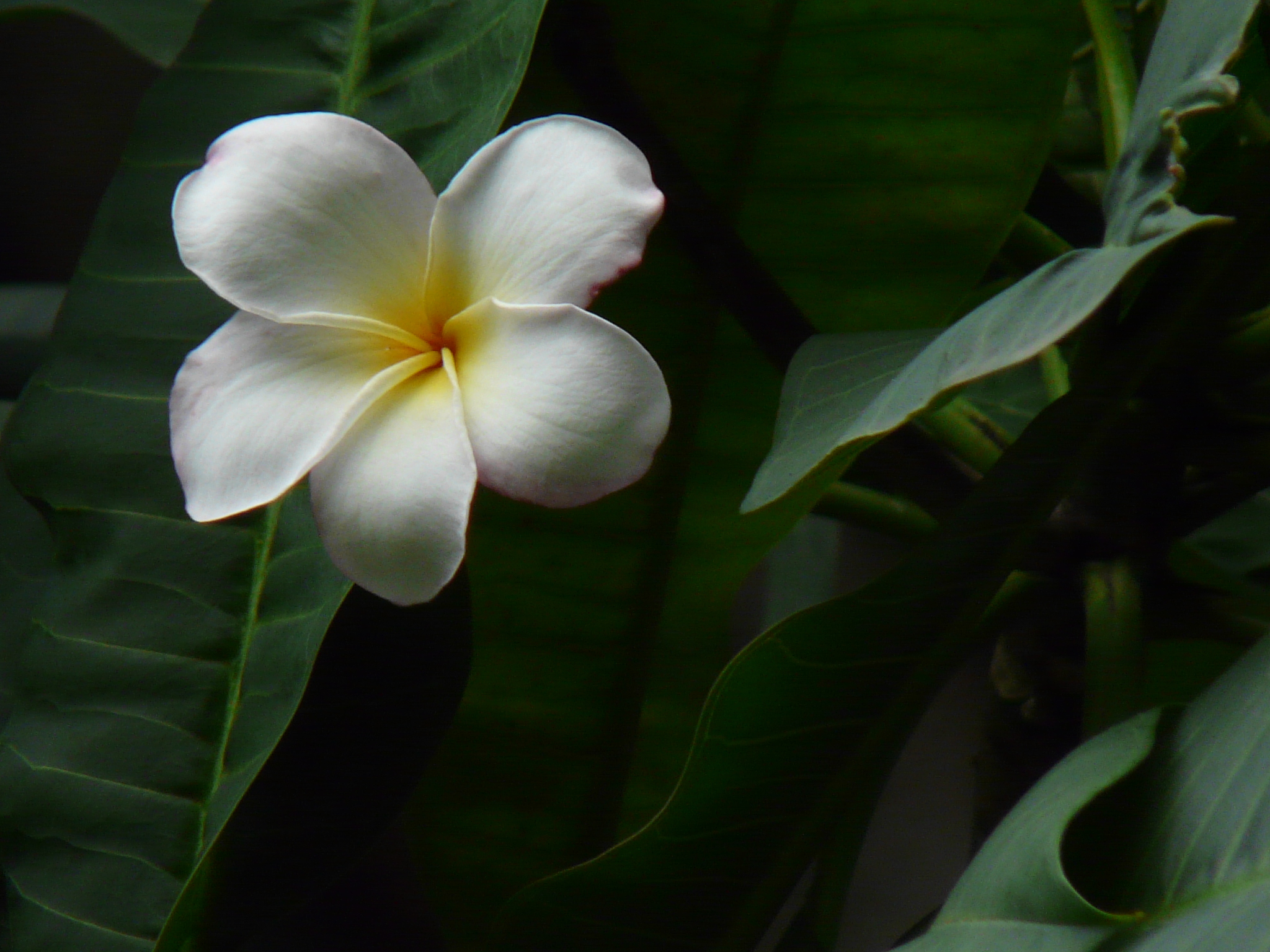
ploo-MEER-ee-a -- named for Charles Plumier, French monk, botanist and illustrator ... Dave's Botanary
ROO-bruh -- red colored ... Dave's Botanary
commonly known as: frangipani, plumeria, temple tree • Assamese: গুলঞ্চ gulancha • Bengali: দালান ফুল dalan-phul, গরুড়-চাঁপা gorur-champa, কাঠগোলাপ kathgolap • Bru: chhi-chu • Dogri: सूहा गुलचैन suha gulchain • Garhwali: पारिजात parijat • Gujarati: ચંપો champo, ધોળો ચંપો dholo champo, ખડચંપો khadchampo • Haryanvi: गोलाचिन golachin • Hindi: चम्पा champa, गोबर चंपा gobar champa, गुलचीन gulachin • Kachchhi: ખડ ચંપો khad champo • Kannada: ದೇವಕಣಿಗಿಲೆ deva kanigile, ಗೋಸಂಪಿಗೆ gosampige, ಕಾಡುಸಂಪಿಗೆ kaadu-sampige, ಮೊಗಗಣಿಗಲು mogaganigalu • Karbi: mir-kong-long-arong • Kashmiri: گُل چین gul-e-cheen • Kokborok: গোলাচী golachi • Konkani: चँपें chaempae, चाफा chafa, देवचाम्पो dev-champo, खैंरचाम्पो khair-champo • Malayalam: ഈഴച്ചെമ്പകം ezhachampakam, വെള്ളച്ചെമ്പകം vellachampakam • Manipuri: ꯈꯥꯒꯤ ꯂꯩꯍꯥꯑꯣ khagi leihao • Marathi: गुलाचीन gulachin, खुरचाफा khurchafa, पांढरा चाफा pandhara chafa • Mizo: bangla-par, par-rim-tui, thingthau, vaingai • Nepali: चोया फूल choya phool, गलैँची galainchee • Odia: କାଠଚମ୍ପା katha champa, ନାଲିଆ କାଠଚମ୍ପା nalia katha champa, ନିଘଣ୍ଟିକା nighantika, ପଦ୍ମ ଗୁଳୁଚି padma guluchi, ସାତ ଡଙ୍କିଆ sata dankia • Persian: گُلچیں gul-achin • Punjabi: ਗੁਲਚੀਨ gulchin • Rajasthani: चम्पा champa • Sanskrit: क्षीरचम्पक kshirachampaka • Santali: ᱜᱩᱞᱟᱧᱡ ᱵᱟᱦᱟ gulanj baha • Tamil: ஈழத்தலரி ilattalari, கள்ளிமந்தாரை kallimandarai, பெருங்கள்ளி perungalli • Telugu: అడవి గన్నేరు adavi ganneru, అర్హత గన్నేరు arhatha ganneru, దేవగన్నేరు daeva ganneru, గుత్తి గన్నేరు gutti ganneru, నూరు వరహాలు nuruvarahaalu, వాడ గన్నేరు vaada ganneru, వెయ్యి వరహాలు veyyivarahaalu • Tulu: ಗೋಸಂಪಯಿ gosampayi, ಗೋಸಂಪಿಗೆ gosampige • Urdu: گل چین gul-chin
known for / parts made use of: the flowers, the bark & roots, the milky sap (latex), the leaves ... compiled from the web
botanical names: Plumeria rubra L. ... heterotypic synonyms: Plumeria acuminata W.T.Aiton • Plumeria acutifolia Poir. • Plumeria rubra var. acuminata (W.T.Aiton) R.S.Rao & Balamani • Plumeria rubra f. acutifolia (Poir.) Woodson • Plumeria rubra var. acutifolia (Poir.) L.H.Bailey & E.Z.Bailey • Plumeria rubra f. lutea (Ruiz & Pav.) Woodson • Plumeria rubra f. tricolor (Ruiz & Pav.) Woodson ... and more at POWO, retrieved October 20, 2026
known for / parts made use of: the flowers, the bark & roots, the milky sap (latex), the leaves ... compiled from the web
[>] THE ORTHOGRAPHIC JOURNEY :: Plumiera > Plumieria > Plumeria
The scientific name of this genus underwent a fascinating three-way evolution before reaching modern stabilization. In 1700, French botanist Joseph Pitton de Tournefort originally coined the genus as Plumiera to mirror the exact surname of his contemporary, Charles Plumier. Over the following decades, subsequent European naturalists and printing presses introduced the typographical variant Plumieria by inserting an extra interior "i" to better align with phonetic pronunciation. Finally, in 1753, Carl Linnaeus dropped the variable interior vowels in Species Plantarum, permanently codifying Plumeria as the legally binding, standardized taxonomic spelling. ... compiled from the web.
(●) THE EPONYMOUS FRANGIPANI
Plumeria rubra :: Creator of the Vernacular Baseline
Plumeria rubra :: Creator of the Vernacular Baseline
As the pioneering Plumeria species introduced to the Indian subcontinent from the Neotropics via early European trade routes, Plumeria rubra effectively laid the linguistic foundation for the genus in India. It was this specific species that triggered the generation of rich and diverse regional names — such as Champa or Gulachin in Hindi, Chafa in Marathi, and Deva Ganneru in Telugu — anchoring it deeply into the local lexicon.
Because its aromatic flowers mirrored the sacred status of the indigenous, unrelated true Champa (Magnolia champaca), the tree was immediately incorporated into temple courtyards, daily worship rituals, and residential landscapes, cementing its position far beyond a mere exotic novelty.
When subsequent Plumeria species were introduced, they did not forge independent paths in the local languages. Instead, they were viewed through the linguistic lens already established by P. rubra, inheriting its baseline regional names. While these later arrivals became valued ornamentals in modern landscaping, they never truly earned distinct, historically deep vernacular designations of their own.
So much said — Frangipani and Plumeria are thoroughly synonymous with Plumeria rubra, and vice versa. For every other species within the genus, a specific descriptive modifier is typically prefixed to these baseline names.
... compiled from the web.
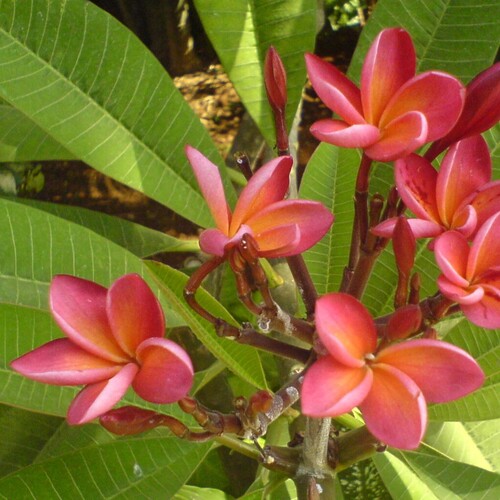
(—) THE RUBRA PARADOX :: the colours of rubra
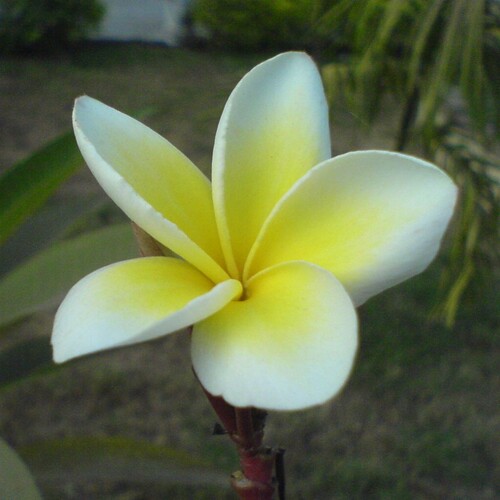
The specific epithet rubra means "red" in Latin. When Linnaeus first described and named the species Plumeria rubra, the specific botanical specimen he was working with had pinkish-red flowers. In botany, the first colour described becomes the permanent name for the entire species, regardless of what colours are discovered later or which variant is more common in the wild.
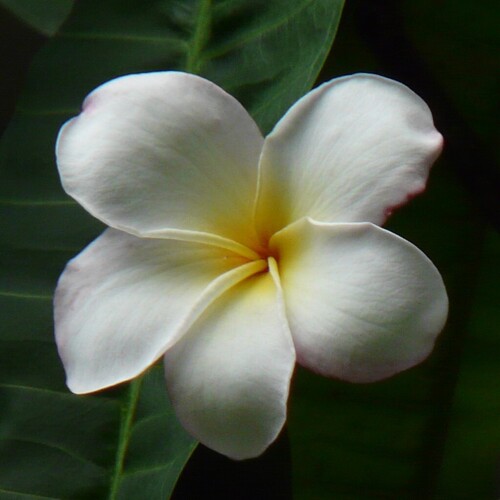
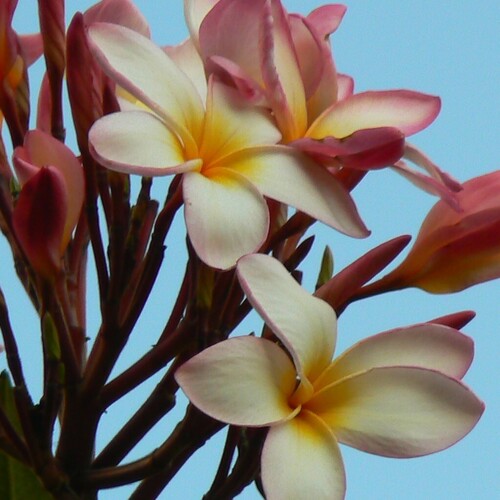
Modern botany recognizes that Plumeria rubra is a single, highly polymorphic species. It naturally exists in several colour forms rather than distinct species. In the wild and in historical introductions across India, the white flower with a yellow centre is the most common form.
The Colour Variants (Forms) of Plumeria rubra
|
forma acutifolia
|
|
forma rubra
|
|
forma lutea
|
|
forma tricolor
|
... compiled from the web — Source: Stephen H. Brown, Identification of the Four Forms of Plumeria rubra, Proc. Fla. State Hort. Soc. 121:406–407. 2008. ... (accessed: October 20, 2026)
Bibliography / etymology / notes
Links listed as references in the notes below, may not remain valid permanently. Portals / websites have a tendency to re-organize / revise their content, leading to change in URLs of pages in their site. Some sites may even close down at their own will. The bits about the languages of India mentioned below are merely some bare facts gathered from the internet; just enough to satisfy curiosity about "where" could the listed names be best prevalent in India. All English transliterated names to be taken sensu amplo.
~~~~~ ENGLISH ~~~~~
written and spoken widely, in most parts of India
frangipani, plumeria
- Flowers of India ... (accessed: October 20, 2026)
temple tree
- for Plumeria acuminata W.T.Aiton ... FRLHT's ENVIS Centre on Medicinal Plants ... (accessed: October 21, 2026)
Frangipani and Plumeria are thoroughly synonymous with Plumeria rubra, and vice versa. For every other species within the genus, a specific descriptive modifier is typically prefixed to these baseline names. ... compiled from the web.
In general English horticultural and travel literature, "Temple Tree" belongs almost exclusively to the genus Plumeria (specifically Plumeria rubra and P. alba). Because colonial-era travelers universally encountered this neotropical tree planted abundantly around Hindu, Buddhist, and Jain temples across south and southeast Asia, "Temple Tree" became the standard, undisputed English label alongside Frangipani. ... compiled from the web.
~~~~~ ASSAMESE ~~~~~
written in: Assamese (অসমীয়া) ... spoken in: Assam, Arunachal Pradesh, Meghalaya
গুলঞ্চ gulancha (variants: গুলচ gulacha, গুলচী gulachi, [—] ৰক্তগুলঞ্চ raktagulancha)
- for Plumeria acutifolia Poir. ... Candrakānta abhidhāna : Asamiyi sabdara butpatti aru udaharanere Asamiya-Ingraji dui bhashara artha thaka abhidhana. 2nd ed. Guwahati : Guwahati Bisbabidyalaya, 1962.
- for Plumeria acutifolia Poir. ... U N Kanjilal, P C Kanjilal, A Das, R N De - Flora of Assam - Vol III
- Deka, B.C., et al. - Baree: The Home Garden of Assam - Indian Council of Agricultural Research (ICAR), Knowledge-based Resources Information Systems Hub for Innovations (KRISHI) Repository ... (accessed: Feb 22, 2022)
These names are shared by Tinospora cordifolia (famously known as Giloy or Guduchi in Ayurveda). In fact, this overlap is one of the most famous examples of cross-species vernacular confusion in Eastern India. Due to centuries of shared linguistic history with Bengali (where Tinospora cordifolia is universally called গুলঞ্চ Gulancha), the terms Gulancha, Gulacha, and Gulachi are actively used interchangeably for both species in Assam.
~~~~~ BENGALI ~~~~~
written in: Bengali (বাংলা) ... spoken in: West Bengal, Assam, Jharkhand, Tripura, Andaman & Nicobar Islands
দালান ফুল dalan-phul
- for Plumeria acuminata W.T.Aiton ... Mukhopadhyay, D. P. & Chakraverty, R. K. (2008) — PLANT WEALTH OF THE RAJ BHAVAN KOLKATA — Occasional Paper - 5 from Raj Bhavan, Kolkata ... (accessed: September 23, 2026)
গরুড়-চাঁপা gorur-champa
- for Plumeria acutifolia Poir. ... PRAIN, DAVID - BENGAL PLANTS - VOL. II
কাঠগোলাপ kathgolap
- উইকিপিডিয়া - একটি মুক্ত বিশ্বকোষ ... Wikipedia - The Free Encyclopedia ... (accessed: October 19, 2026)
While historical Floras and lexicons rely heavily on classical names like Gulancha or Gorur-champa, modern pop-culture and nursery trades have completely embraced Kathgolap (কাঠগোলাপ). Translating to "Wood Rose", this poetic moniker beautifully captures the sight of delicate, rose-like fragrant clusters breaking out from thick, stout, timber-like branches. ... compiled from the web.
~~~~~ BRU ~~~~~
written in: Roman, Bengali, Anji (indigenous script, their sacred heritage) ... spoken in: Tripura, Mizoram and Assam ... other names for this language: Kau Bru / Kaubru / Riang ... spoken by: Reang / Riang / Bru
chhi-chu
- for Plumeria acuminata W.T.Aiton ... List of Ethno-medicinal plants in Mizoram state with uses - Ministry of Ayush ... (downloaded: Feb 9, 2022)
~~~~~ DOGRI ~~~~~
written in: Devanagari (डोगरी) ... spoken in: Jammu & Kashmir ... spoken by the Dogras
सूहा गुलचैन suha gulchain
- Many thanks to OM Prakash Vidyarthi for help with this name ... facebook
~~~~~ GARHWALI ~~~~~
written in: Devanagari (गढ़वळि) ... spoken in: Uttarakhand
पारिजात parijat
- Rawat, Megha & Vasistha, Harsh & Manhas, Rajesh & Negi, Mridula. (2013). FLORISTIC DIVERSITY OF THE KUNJAPURI SACRED GROVE, GARHWAL HIMALAYA, INDIA. Journal of the Bombay Natural History Society. 110. 57-64. ... (downloaded: Sept 10, 2023)
A fascinating socio-religious vernacular shift where the ancient, sacred Sanskrit name parijat (traditionally tied to Nyctanthes arbor-tristis) has been locally bestowed upon Plumeria rubra. This folk-botanical borrowing is triggered by the tree's intense fragrance, its yellow-centered white blossoms, and its prominent cultivation around high-altitude Himalayan temple shrines. ... compiled from the web.
~~~~~ GUJARATI ~~~~~
written in: Gujarati (ગુજરાતી) ... spoken in: Gujarat, Dadra & Nagar Haveli, Daman & Diu
ચંપો champo
- Biological Diversity of Gujarat - published by Gujarat Ecology Commission ... (downloaded: Dec 16, 2020)
- Patel, Mayur & Punjani, Bhasker. (2021). A study of angiosperm diversity in Bayad taluka of Aravalli district, Gujarat. - International Journal of Botany. 6. 709-718. ... (downloaded: Sep 15, 2023)
ધોળો ચંપો dholo champo
- for Plumeria acutifolia Poir. ... વનસ્પતીઓ ના ગુજરાતી તથા બોટનીકલ નામ ની યાદી :: સંકલન કર્તા વૈધ શ્રી કે,જે,ઝાલા ... (downloaded: 19 Jan 2026)
- [—] ધોળો dholo = white-coloured
ખડચંપો khadchampo
- for Plumeria acutifolia Poir. ... વનસ્પતીઓ ના ગુજરાતી તથા બોટનીકલ નામ ની યાદી :: સંકલન કર્તા વૈધ શ્રી કે,જે,ઝાલા ... (downloaded: 19 Jan 2026)
- Bimal S Desai - Floristic Diversity and Ethnobotany of Chhota Udepur Forest Division :: Chapter 4 :: Shodhganga - a reservoir of Indian theses @ INFLIBNET
- Biological Diversity of Gujarat - published by Gujarat Ecology Commission ... (downloaded: Dec 16, 2020)
- S Rajendra Kumar, S Kalavathy (2010) - Floristic status and its conservation in the forests of the north Gujarat region (NGR) Gujarat, India :: Chapter 4 :: Shodhganga :: a reservoir of Indian theses @ INFLIBNET
~~~~~ HARYANVI ~~~~~
written in: Devanagari (हरियाणवी or हरयाणवी) ... spoken in: Haryana, Delhi
गोलाचिन golachin
- Haryana Forest Flora - A Comprehensive Database of Ligneous Plants of Haryana (India) ... (accessed: October 24, 2026)
~~~~~ HINDI ~~~~~
written in: Devanagari (हिन्दी) ... spoken in: Delhi, Uttar Pradesh, Bihar, Chhattisgarh, Haryana, Jharkhand, Madhya Pradesh, Rajasthan, Uttarakhand
चम्पा champa (or चंपा champa)
- Wagh, Vijay & Jain, Ashok. (2014). Floristic Diversity of Jhabua District, Madhya Pradesh, India. 6. 146-167. 10.5829/idosi.ajps.2013.6.4.1116. ... (downloaded: Nov 12, 2024)
गोबर चंपा gobar champa, गुलचीन gulachin (variant: गुलैंची gulainchi)
- for Plumeria acutifolia Poir. ... PRAIN, DAVID - BENGAL PLANTS - VOL. II
- for Plumeria acuminata W.T.Aiton ... FRLHT's ENVIS Centre on Medicinal Plants ... (accessed: October 21, 2026)
The popular Hindi name Gulachin (गुलचीन) is often mistaken as meaning "Flower of China". It is actually derived from the Persian Gul-chin, meaning "The Hand-Picked Bloom" or "The Elite Selection" — a poetic nod to how these beautiful blossoms remain pristine and intensely fragrant long after being plucked from the tree. ... compiled from the web.
The universal application of the name Champa (चम्पा / चंपा) to Plumeria rubra is a historical loan from the indigenous, unrelated True Champa (Magnolia champaca, formerly Michelia champaca). Because the introduced neotropical tree produced intensely aromatic blossoms with a similar central golden glow, it was culturally absorbed into the pre-existing sacred framework of the native Champak. ... compiled from the web.
~~~~~ KACHCHHI ~~~~~
written in: Gujarati (કચ્છી), Sindhi (ڪڇّي) ... spoken in: Kutch region of Gujarat
ખડ ચંપો khad champo
- Patel, Yatin & Patel, Rohitkumar & Pankaj, Joshi & Dabgar, Yogesh. (2011). Study of the Angiospermic flora of Kachchh district, Gujarat, India. Life Sciences Leaflets. 19. 739-768. ... (downloaded: Feb 9, 2022)
While early master monographs like Jaikrishna Indraji Thakar's Plants of Cutch and their Utility (1926) omitted the plant due to its early status as a non-utility palace ornamental, modern field checklists register it universally as khad champo. The descriptive prefix khad- meaning "rock/stony ridge" highlights the tree's remarkable succulent hardiness and ability to thrive across arid, rocky landscapes. ... compiled from the web.
~~~~~ KANNADA ~~~~~
written in: Kannada (ಕನ್ನಡ) ... spoken in: Karnataka
ದೇವಕಣಿಗಿಲೆ deva kanigile (variant: ದೇವಗಣಿಗಲು devaganigalu), ಗೋಸಂಪಿಗೆ gosampige
- Alar - an authoritative Kannada-English dictionary corpus created by V. Krishna
- Subrahmanya, Prasad K - Exploration and elucidation of traditional medicinal plants of erstwhile Tulunadu and surrounding area of Kerala and Karnataka :: Chapter 4 :: Shodhganga - a reservoir of Indian theses @ INFLIBNET
ಕಾಡುಸಂಪಿಗೆ kaadu-sampige (variants: ಕಾಡುಸಂಪಗೆ kaadu-sampage, ಕಾಡಸಂಪಗೆ kaada-sampage)
- for Plumeria acutifolia Poir. ... Kittel, Ferdinand. Kittel's Kannada-English dictionary. Rev. and enl. ed. [Madras] University of Madras, 1968-1971.
- Alar - an authoritative Kannada-English dictionary corpus created by V. Krishna
- The prefix Kaadu / Kaada meaning "wild" serves as a classic folk-botanical descriptor to distinguish this coarse, thick-timbered neotropical introduction from the slender, native "True Sampige" (Magnolia champaca). ... compiled from the web.
ಮೊಗಗಣಿಗಲು mogaganigalu (variants: ಮಗಗಣಗಿಲ magaganagila, ಮಗಕಣಗಿಲ magakanagila)
- Alar - an authoritative Kannada-English dictionary corpus created by V. Krishna
- for Plumeria acutifolia Poir. ... Kittel, Ferdinand. Kittel's Kannada-English dictionary. Rev. and enl. ed. [Madras] University of Madras, 1968-1971.
The word Gove (ಗೋವೆ) is the traditional, historical Kannada and Tulu regional name for the territory of Goa (often historically referred to as "Gove" or "Gova" in Kadamba-era inscriptions across coastal Karnataka). Therefore, ಗೋವೆಸಂಪಿಗೆ govesampige literally translates to "The Goa Champa". When Plumeria rubra was introduced to India by European maritime networks, one of its primary drop-off, cultivation, and distribution hubs was Portuguese Goa. From Goa, the plant migrated south down the Konkan coast into Tulunadu (Coastal Karnataka — Udupi and Dakshina Kannada districts) and the Uttara Kannada district via Mangalore and Karwar ports. Because the local populations in these coastal and Malnad belts received this highly fragrant, exotic tree directly from or via Goa, they organically crowned it the "Sampige that came from Goa" (Govesampige) to differentiate it from interior variants. ... compiled from the web.
~~~~~ KARBI ~~~~~
written in: Roman ... spoken in: Arunachal Pradesh, Assam, Meghalaya, Nagaland ... other names for this language: Mikir or Arleng
mir-kong-long-arong
- for Plumeria acutifolia Poir. ... U N Kanjilal, P C Kanjilal, A Das, R N De - Flora of Assam - Vol III
~~~~~ KASHMIRI ~~~~~
written in: Koshur (Perso-Arabic كٲشُر), Devanagari (कश्मीरी) ... spoken in: Kashmir ... other names for this language: Koshur
گُل چین gul-e-cheen
- Flowers of India ... (accessed: October 20, 2026)
Due to sub-zero winter temperatures, Plumeria rubra cannot survive ground cultivation in the Kashmir Valley. However, it remains highly viable as a container-grown plant under a seasonal management routine. To prevent fatal frost damage, pots are moved indoors before autumn. During this winter dormancy phase, irrigation is completely suspended. When returned outdoors to full summer sun, the plant successfully produces robust, fragrant tropical blossoms.
~~~~~ KOKBOROK ~~~~~
written in: Koloma, Latin, Bengali–Assamese (ককবরক), Kokmari ... spoken in: Tripura ... other names for this language: Tripuri, Kokbarak, Tippera, Tipra, Trippera
গোলাচী golachi
- for Plumeria rubra var. acutifolia (Poir.) L.H.Bailey & E.Z.Bailey ... Dr. Kishore Deb Barma - Tribal Folk Medicine of Tripura - Tribal Research and Cultural Institute, Government of Tripura ... (downloaded: Jan 25, 2025)
~~~~~ KONKANI ~~~~~
written in: Devanagari (कोंकणी) / Kannada (ಕೊಂಕಣಿ) / Malayalam (കൊങ്കണി) / Perso-Arabic (کونکنی) / Romi (Konknni) ... spoken in: Goa, Karnataka, Maharashtra, Kerala, Gujarat
चँपें chaempae
- native speaker record — Mangalorean Konkani
चाफा chafa
- for Plumeria acutifolia Poir. ... Glimpses of Biodiversity in Panaji - Goa State Biodiversity Board | Corporation of City of Panaji
देवचाम्पो dev-champo
- for Plumeria acuminata W.T.Aiton ... V D Vartak (1966) - Enumeration of plants from Gomantak India with a note on botanical excursions to the Castlerock area :: Chapter 5 :: Shodhganga :: a reservoir of Indian theses @ INFLIBNET
खैंरचाम्पो khair-champo (or खैरचम्पो khair-champo)
- for Plumeria acutifolia Poir. ... Dalgado, Daniel Gelanio. Flora de Goa e Savantvadi: catalogo methodico das plantas medicinaes, alimentares e industriaes. Portugal, Imprensa Nacional, 1898. ... (downloaded: 21 Sept 2020)
- for Plumeria acuminata W.T.Aiton ... V D Vartak (1966) - Enumeration of plants from Gomantak India with a note on botanical excursions to the Castlerock area :: Chapter 5 :: Shodhganga :: a reservoir of Indian theses @ INFLIBNET
खैंरचाम्पो khair-champo — A highly distinct historic regional vernacular where the prefix khair- refers to the rough, dry bark of Acacia catechu. It serves as a structural folk-botanical descriptor, comparing the thick, naked winter branch network of the introduced Plumeria rubra (historical synonym P. acutifolia) to the timber structure of the native Khair wood tree. ... compiled from the web.
~~~~~ MALAYALAM ~~~~~
written in: Malayalam (മലയാളം) ... spoken in: Kerala, Lakshadweep
ഈഴച്ചെമ്പകം ezhachampakam, വെള്ളച്ചെമ്പകം vellachampakam
- Subrahmanya, Prasad K - Exploration and elucidation of traditional medicinal plants of erstwhile Tulunadu and surrounding area of Kerala and Karnataka :: Chapter 4 :: Shodhganga - a reservoir of Indian theses @ INFLIBNET
Ezham (ഈഴം) — An ancient Tamil / Malayalam geographic term referring to Sri Lanka (Ceylon); Chempakam (ചെമ്പകം) — The regional adaptation of the word Champa (referring to the fragrant Magnolia champaca). ഈഴച്ചെമ്പകം ezhachampakam literally translates to "The Sri Lankan Champa". When Portuguese and Dutch trade fleets introduced Plumeria rubra to the southwestern Malabar coast, it arrived via their established colonial trading hubs in Sri Lanka. The local population instantly recognized it as an exotic, foreign import coming from across the Gulf of Mannar, beautifully embedding its trade route directly into its Malayalam title. ... compiled from the web.
~~~~~ MANIPURI ~~~~~
written in: Meiteilon (ꯃꯩꯇꯩꯂꯣꯟ), Bengali-Assamese ... spoken in: Manipur ... other names for this language: Meetei
ꯈꯥꯒꯤ ꯂꯩꯍꯥꯑꯣ khagi leihao
- Sharma, H. Surmangol. Learners' Manipuri-English dictionary. Imphal : Sangam Book Store, 2006.
- Flowers of India ... (accessed: October 20, 2026)
- Singh S. Sukumar. The Economic Plants of Manipur and Their Uses, Manipur, 2006, 2009.
[—] colour variants:
- red — ꯈꯥꯒꯤ ꯂꯩꯍꯥꯑꯣ ꯑꯉꯥꯡꯕ khagi leihao angangba
- white — ꯈꯥꯒꯤ ꯂꯩꯍꯥꯑꯣ ꯑꯉꯧꯕ khagi leihao angouba
~~~~~ MARATHI ~~~~~
written in: Devanagari (मराठी) ... spoken in: Maharashtra, Karnataka
गुलाचीन gulachin (or गुलचिनी gulachini)
- [>] for Plumieria ... Molesworth, J. T. (James Thomas). A dictionary, Marathi and English. 2d ed., rev. and enl. Bombay: Printed for government at the Bombay Education Society's press, 1857.
खुरचाफा khurchafa
- for Plumeria acutifolia Poir. ... डॉ मल्हार विनायक आपटे — वनश्रीसृष्टी खंड १ — महाराष्ट्र राज्य साहित्य आणि संस्कृती मंडळ ... (downloaded: Sep 16, 2016)
- for Plumeria rubra var. acutifolia (Poir.) L.H.Bailey & E.Z.Bailey ... The Gazetteer Department - Maharashtra State ... महाराष्ट्रातील वनस्पतीशास्त्र आणि वनसंपदा ... (downloaded: Sep 5, 2020)
पांढरा चाफा pandhara chafa
- for Plumeria rubra var. acutifolia (Poir.) L.H.Bailey & E.Z.Bailey ... The Gazetteer Department - Maharashtra State ... महाराष्ट्रातील वनस्पतीशास्त्र आणि वनसंपदा ... (downloaded: Sep 5, 2020)
- [—] पांढरा pandhara = white-coloured
~~~~~ MIZO ~~~~~
written in: Latin, Bengali-Assamese ... spoken in: Mizoram ... other names for this language: Lushai, Duhlian
bangla-par, par-rim-tui
- O. P. Singh et al. - State of Environment Report of Mizoram 2016 - Department of Environment, Forests & Climate Change, Government of Mizoram ... (downloaded: Feb 9, 2022)
thingthau
- for Plumeria acuminata W.T.Aiton ... R.Thansanga - Mizoram Hmulphurh leh Thlai Hmingte (Mizo - Botanical names) THUHMAHRUAI ... (downloaded: Aug 30, 2023)
vaingai
- for Plumeria acuminata W.T.Aiton ... List of Ethno-medicinal plants in Mizoram state with uses - State Medicinal Plants Board - Mizoram
The bangla-par carries a historic dual etymology validated by J. H. Lorrain's classical dictionary: it functions both as a geographic nod to the plains of Bengal and as a literal description meaning "The Dak Bungalow Flower", highlighting how the species was standardly planted around colonial-era government. ... compiled from the web.
thingthau translates literally to "The Fat Tree", serving as a vivid morphological folk-descriptor that captures the tree's unusually thick, blunt, succulent branch architecture. ... compiled from the web.
~~~~~ NEPALI ~~~~~
written in: Devanagari (नेपाली) ... spoken in: Nepal, West Bengal, Assam, Sikkim, Himachal Pradesh, Uttarakhand, Jammu & Kashmir
चोया फूल choya phool, गलैँची galainchee
- Many thanks to Saroj Kumar Kasaju for help with these names ... eFloraofIndia
~~~~~ ODIA ~~~~~
written in: Odia (ଓଡ଼ିଆ) ... spoken in: Odisha, Andaman & Nicobar Islands
କାଠଚମ୍ପା katha champa
- for Plumeria acuminata W.T.Aiton ... Praharaj, G.C. Pūrṇṇachandra Orḍiā bhāshākosha: a lexicon of the Oriya language. Cuttack: Utkal Sahitya Press, 1931-1940.
- Sudam Charan Sahu, Sabita Tudu, Namita Maharana, Sifan Priyadarshini. (2024). Assessment of plant diversity in Maharaja Sriram Chandra Bhanja Deo University Campus, Odisha, India. Sustainability and Biodiversity Conservation, 3(2), 1–25. ... (downloaded: July 21, 2026)
- Sethi, Jashabanta & Kumar, Sanjeet & Supriya Devi, Rajkumari & Mishra, Sweta & Marndi, Sugimani & Rout, Subhalakshmi & Jena, Nibedita. (2026). Floral Diversity of Rourkela Forest Division, Odisha. ... (downloaded: June 27, 2026)
- Kumar, Sanjeet & Supriya Devi, Rajkumari. (2020). Report on Floral Diversity of SAMBHAV, Nayagarh, Odisha, India. 10.13140/RG.2.2.21260.54402. ... (downloaded: July 4, 2023)
- Visual Guide to Wild Medicinal Plants of Orissa - 2007, The State Medicinal Plants Board (SMPB), Odisha ... (downloaded: Nov 10, 2024)
- Medicinal Plants Knowledge Centre, Bhubaneswar, PCCF & HoFF, Odisha State Forest Department ... (downloaded: June 18, 2024)
- Prusti, Aratibala and Kambaska Kumar Behera. "Ethno-Medico Botanical Study of Sundargarh District, Orissa, India." Ethnobotanical Leaflets 2007 (2007): 15. ... (downloaded: Oct 14, 2024)
ନାଲିଆ କାଠଚମ୍ପା nalia katha champa
- Das P K, Sahoo T, Panda P C. Forest trees of Odisha, India: An updated checklist. Plant Science Today. 2022; 9(4): 1021–1031. ... (downloaded: Aug 29, 2023)
ନିଘଣ୍ଟିକା nighantika, ସାତ ଡଙ୍କିଆ sata dankia
- for Plumeria acuminata W.T.Aiton ... Praharaj, G.C. Pūrṇṇachandra Orḍiā bhāshākosha: a lexicon of the Oriya language. Cuttack: Utkal Sahitya Press, 1931-1940.
ପଦ୍ମ ଗୁଳୁଚି padma guluchi
- Praharaj, G.C. Pūrṇṇachandra Orḍiā bhāshākosha: a lexicon of the Oriya language. Cuttack: Utkal Sahitya Press, 1931-1940.
The baseline katha champa describes delicate blossoms breaking out from bare, timber-like wood stalks. The highly specific variant nalia katha champa utilizes the Odia colour prefix nalia meaning "red", to explicitly isolate the crimson-pink forms (Plumeria rubra f. rubra) [—]. The classical nighantika denotes its historical medical registry, while padma guluchi compares its fleshy stems to the Tinospora vine. The folk-name sata dankia visually references the tree's heavy, multi-branched candelabra canopy architecture. ... compiled from the web.
~~~~~ PERSIAN ~~~~~
written in: Farsi (فارسی) ... almost a defunct language; spoken in: West Bengal, Jharkhand, Maharashtra, Bihar
گُلچیں gul-achin (variant: گُلِ چِین gul-e-chin)
- for Plumeria acuminata W.T.Aiton ... Platts, John T. (John Thompson). A dictionary of Urdu, classical Hindi, and English. London: W. H. Allen & Co., 1884.
- for Plumeria acuminata W.T.Aiton ... Fallon, S. W.A new Hindustani-English dictionary, with illustrations from Hindustani literature and folk-lore. Banaras, London: Printed at the Medical Hall Press; Trubner and Co., 1879.
~~~~~ PUNJABI ~~~~~
written in: Gurmukhi (ਪੰਜਾਬੀ) ... spoken in: Punjab
ਗੁਲਚੀਨ gulchin
- for Plumeria acutifolia Poir. ... Bamber, Charles James - Plants of the Punjab : a descriptive key to the flora of the Punjab, North-west Frontier Province, and Kashmir, the names of plants listed in this book are a mix of Punjabi, Hindi and Urdu ... (downloaded: Jan 7, 2023)
~~~~~ RAJASTHANI ~~~~~
written in: Devanagari (राजस्थानी) ... spoken in: Rajasthan
चम्पा champa (or चंपा champa)
- R. P. Kanther - DOMINANT FLORA OF PALI-DISTRICT, RAJASTHAN, INDIA J. Indian Bot. Soc., Vol. 100 (1&2) 2020:01-15 ... (downloaded: Jun 15, 2024)
- Manju Chaudhary and S.K. Shringi - Floristic Composition of Beer Jhunjhunu Conservation Reserve of Rajasthan, India - The Biobrio 4(1 & 2), 2017 ... (downloaded: Feb 9, 2022)
~~~~~ SANSKRIT ~~~~~
written in: Devanagari (संस्कृतम्) ... used all over India by priests and scholars
क्षीरचम्पक kshirachampaka
- for Plumeria acuminata W.T.Aiton ... FRLHT's ENVIS Centre on Medicinal Plants ... (accessed: October 21, 2026)
~~~~~ SANTALI ~~~~~
written in: Ol Chiki (ᱥᱟᱱᱛᱟᱲᱤ), Bengali (সাঁওতালী), Odia (ସାନ୍ତାଳୀ), Devanagari (सान्ताली), Roman ... spoken in: Jharkhand, West Bengal, Odisha
ᱜᱩᱞᱟᱧᱡ ᱵᱟᱦᱟ gulanj baha
- for Plumeria acutifolia Poir. ... Campbell, A., of the Santal mission A Santali-English dictionary Pokhuria, India : Santal Mission Press, 1899
- for Plumeria acutifolia Poir. ... Records of the Botanical Survey of India by Botanical Survey of India ... (accessed: October 23, 2026)
An authentic indigenous Munda vernacular where the primary term gulanj represents a specialized tribal phonetic evolution of the regional gulancha baseline, paired with the native Santali word baha (flower). It cleanly catalogs the naturalized status of the white-flowered Plumeria acutifolia across the homesteads and medicinal folklore of the Chota Nagpur plateau. ... compiled from the web.
~~~~~ TAMIL ~~~~~
written in: Tamil (தமிழ்) ... spoken in: Tamil Nadu, Puducherry, Andaman & Nicobar Islands
ஈழத்தலரி ilattalari
- for Plumeria acutifolia Poir. ... University of Madras. Tamil lexicon. [Madras], University of Madras, 1924-1936.
கள்ளிமந்தாரை kallimandarai
- for "Pagoda tree" ... University of Madras. Tamil lexicon. [Madras], University of Madras, 1924-1936.
பெருங்கள்ளி perungalli
- for Plumeria acuminata W.T.Aiton ... Winslow, Miron. A comprehensive Tamil and English dictionary of high and low Tamil. Madras: P.R. Hunt, 1862.
- Gupta M, Mazumder UK, Gomathi P, Selvan VT. Antiinflammatory evaluation of leaves of Plumeria acuminata. BMC Complement Altern Med. 2006 Nov 2;6:36. doi: 10.1186/1472-6882-6-36. PMID: 17081283; PMCID: PMC1654182. ... (accessed: October 22, 2026)
ஈழத்தலரி ilattalari — A highly significant historical compound where the prefix Ilam- refers to Sri Lanka. It serves as a geographical trade-marker, documenting the plant's introduction route from the Neotropics to the Tamil coast via colonial-era Sri Lankan hubs. The term alari places it correctly within the milky-sapped dogbane family. The name ஈழத்தலரி (ilattalari) translates literally to "The Sri Lankan Oleander-Flower". ... compiled from the web.
The variant கள்ளிமந்தாரை kallimandarai is historically registered as the definitive "Pagoda tree" vernacular, utilizing a vivid descriptive blend that pairs the tree's succulent, milk-hedgerow growth (kalli) with its spectacular, orchid-like fragrant blooms (mandarai).
While classical dictionaries isolate பெருங்கள்ளி perungalli under P. alba, standard field Floras and medical registries apply it as a generic baseline for Plumeria rubra (historical synonym P. acuminata). The name translates literally to "Big Succulent/Spurge", describing the tree's unique, latex-rich, blunt branch skeleton. ... compiled from the web.
~~~~~ TELUGU ~~~~~
written in: Telugu ( తెలుగు) ... spoken in: Andhra Pradesh, Telangana, Puducherry
అడవి గన్నేరు adavi ganneru, అర్హత గన్నేరు arhatha ganneru, దేవగన్నేరు daeva ganneru, గుత్తి గన్నేరు gutti ganneru, నూరు వరహాలు nuruvarahaalu, వాడ గన్నేరు vaada ganneru, వెయ్యి వరహాలు veyyivarahaalu
- Flora Andhrika - Plant Wealth of Andhra Pradesh, India ... (accessed: October 23, 2026)
- for Plumeria acuminata W.T.Aiton ... FRLHT's ENVIS Centre on Medicinal Plants ... (accessed: October 23, 2026)
The baseline entries daeva-ganneru and vaada-ganneru highlight the plant's naturalized status across temple courtyards and domestic estates. The morphology is captured by gutti-ganneru (describing clustered blossoms), while the highly poetic folk-names nuruvarahaalu ("one hundred gold coins") and veyyivarahaalu ("one thousand gold coins") describe the visual effect of the golden-centered blossoms covering the canopy. ... compiled from the web.
~~~~~ TULU ~~~~~
written in: Tigalari (Tulu) was used for writing Vedic texts in Sanskrit, Kannada (ತುಳು), Malayalam (തുളു) ... spoken in: Karnataka, north Kerala
ಗೋಸಂಪಯಿ gosampayi, ಗೋಸಂಪಿಗೆ gosampige (or ಗೋಸಂಪಗೆ gosampage)
- Subrahmanya, Prasad K - Exploration and elucidation of traditional medicinal plants of erstwhile Tulunadu and surrounding area of Kerala and Karnataka :: Chapter 4 :: Shodhganga - a reservoir of Indian theses @ INFLIBNET
- for Plumeria acuminata W.T.Aiton ... Männer, A - Tulu-English and English-Tulu dictionary - Mangalore, Basel Mission Press (1886-8)
~~~~~ URDU ~~~~~
written in: Urdu (اردو) ... spoken in: Uttar Pradesh, Delhi, Bihar, Maharashtra, Andhra Pradesh, Telangana, Karnataka
گل چین gul-chin
- ويكيپيڈيا - آزاد دائرۃ المعارف ... Wikipedia - The Free Encyclopedia ... (accessed: October 22, 2026)
~~~~~ KNOWN DISTRIBUTION in INDIA ~~~~~
introduced during the colonial era / widely planted, cultivated in urban landscapes / planted, naturalized in rural regions
- Hassler, Michael (1994 - 2026): World Plants. Synonymic Checklist and Distribution of the World Flora. Version 26.08; last update Aug. 2nd, 2026. Last accessed 20/10/2026 (dd/mm/yyyy).
~~~~~
Created on: 13:46 20-10-2026 ¦ Last updated: 11:44 26-10-2026 (DD-MM-YYYY)
~~~~~
.