
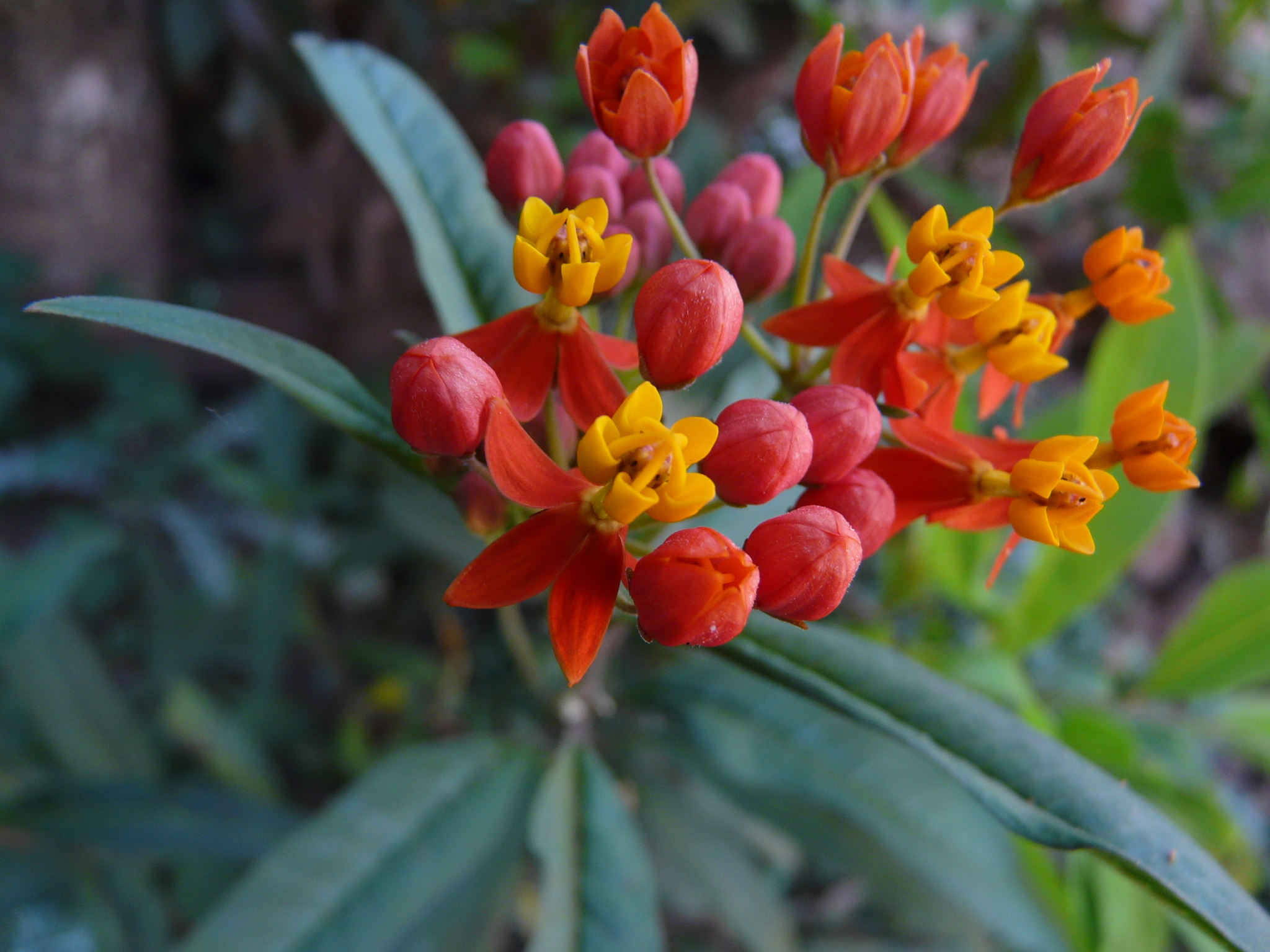
ass-KLE-pee-us -- named for Asklepios, the god of healing in Greek mythology ... Dave's Botanary
ku-ra-SAV-ik-uh -- of or from Curaçao, a Dutch Caribbean island ... Dave's Botanary
commonly known as: bloodflower, Curassavian swallow-wort, false ipecac, Indian root, scarlet milkweed, silkweed, West Indian ipecacuanha • Assamese: আকন লতা akon lota, ভাদৈ তিতা ফুল bhadoi tita phul • Bengali: কাকতুণ্ডী kaktundi, কৃষ্ণকলি krishna-kali • Bodo: खिम-नाना khim-nana • Dogri: रत्तफुल rattphul • Garhwali: काकतुण्डी kaktundi, लाइमा laima • Gujarati: કાકતુંડી kakatundi • Hajong: আকান্দা লেৱা akanda lewa • Haryanvi: काकाटुन्डी kakatundi • Hindi: काकाटुन्डी kakatundi, कौरा डोडी kaura dodi • Kachchhi: કાકતુંડી kakatundi • Kannada: ಚದುರಂಗಿ ಗಿಡ chadurangi gida, ಹುಲುಗಿಲು ಗಿಡ hulugilu gida, ಕಾಕತುಂಡಿ kakatundi • Kokborok: কালী-সাম kali-sam • Konkani: कुडकी kurki • Kuki: langthlei • Kullui: काकतुण्डी kaktundi • Malayalam: ചെമ്മുള്ളി ചെടി chemmulli chedi, കമ്മൽ ചെടി kammal chedi • Malvani: कुडकी kurki • Manipuri: ꯀ꯭ꯔꯤꯁꯅꯥꯆꯨꯔꯥ krishnachura • Marathi: हळद कुंकूं halad kunku, काकतुंडी kakatundi, कुडकी kurki, कुरकी kuraki, पिवळा चित्रक pivla chitrak • Mizo: ding-di • Nepali: खुर्सानी कोशे फूल khursaani koshe phool, हिरालाल hiraalaal, माछा फूल maachhaa phool, मदाने madaane, शनिखार shanikhaar • Rabha: আখম লেৱা akhom-lewa • Sanskrit: काकनासिका kakanasika, काकतुण्डी kakatundi • Tamil: அரியமான் ariyaman, ககாதுண்டி kakaathundi • Telugu: అగ్ని జిల్లేడు agni jilledu, జిల్లేడు మందార jilledu mandara • Tulu: ಚದುರಂಗಿ chadurangi
known for / parts made use of: a keystone ecological host plant, roots, stems, leaves & flowers, seed pods & fluff, the milky sap / latex ... compiled from the web
botanical names: Asclepias curassavica L. ... homotypic synonyms: Asclepias aurantiaca Salisb. • Asclepias bicolor Moench • Asclepias nivea var. curassavica (L.) Kuntze ... heterotypic synonyms: Asclepias cubensis Wender. • Asclepias margaritacea Hoffmanns. ex Schult. ... and more at POWO, retrieved 13 July 2026
known for / parts made use of: a keystone ecological host plant, roots, stems, leaves & flowers, seed pods & fluff, the milky sap / latex ... compiled from the web
Bibliography / etymology / notes
Links listed as references in the notes below, may not remain valid permanently. Portals / websites have a tendency to re-organize / revise their content, leading to change in URLs of pages in their site. Some sites may even close down at their own will. The bits about the languages of India mentioned below are merely some bare facts gathered from the internet; just enough to satisfy curiosity about "where" could the listed names be best prevalent in India. All English transliterated names to be taken sensu amplo.
~~~~~ ENGLISH ~~~~~
written and spoken widely, in most parts of India
bloodflower, false ipecac
- Umrao Singh, A M Wadhwani, B M Johri - Dictionary of Economic Plants in India - Second Edition 1983, Indian Council of Agricultural Research, New Delhi
Curassavian swallow-wort, West Indian ipecacuanha
- The Useful Plants of India (CSIR, Publications & Information Directorate)
- Sir George Watt - A Dictionary of the Economic Products of India - Volume 1
Indian root, scarlet milkweed, silkweed
- Flowers of India ... (accessed: July 13, 2026)
- Indian Root (Historical English Trade Name): A 17th-century maritime trade term. It does not reference India, but rather the West Indies (the Caribbean), where the plant is native. Early European traders coined the name after observing the indigenous "West Indian" tribes heavily utilizing the plant's thick, emetic roots in traditional medicine. ... compiled from the web.
~~~~~ ASSAMESE ~~~~~
written in: Assamese (অসমীয়া) ... spoken in: Assam, Arunachal Pradesh, Meghalaya
আকন লতা akon lota
- Deka, Dipali (2007) - Ethno medico botanical study of certain tribes of Goalpara district, Assam :: Chapter 5 - Shodhganga :: a reservoir of Indian theses @ INFLIBNET
- আকন লতা akon lota — A folk-taxonomic variant where lota (creeper / slender stem) is appended to akon (milkweed) to differentiate its slender, weak-stemmed habit from the robust native Calotropis shrub. ... compiled from the web.
ভাদৈ তিতা ফুল bhadoi tita phul
- Many thanks to Late Brahmananda Patiri for help with this name ... facebook
- Sharma, Pratibha & Sarma, Jintu & Sarma, C.M. (2019). Ethnobotany and micropropagation of Asclepias curassavica L. (Apocynaceae) – a medicinally potent naturalized plant in India. Pleione 13(2):227 ... (accessed: July 14, 2026)
- ভাদৈ তিতা ফুল bhadoi tita phul — literally "the bitter flower of the monsoon month of Bhado" | ভাদৈ bhadoi: This refers directly to bhado (ভাদ), the fifth month of the traditional Assamese calendar (which corresponds to the late monsoon month) | তিতা tita: meaning "bitter" | ফুল phul: meaning "flower". ... compiled from the web.
~~~~~ BENGALI ~~~~~
written in: Bengali (বাংলা) ... spoken in: West Bengal, Assam, Jharkhand, Tripura, Andaman & Nicobar Islands
কাকতুণ্ডী kaktundi (or কাকতুন্ডী kaktundi), কৃষ্ণকলি krishna-kali
- Majumdar, Koushik & Datta, B. (2007). A study on ethnomedicinal usage of plants among the folklore herbalists and Tripuri medical practitioners: Part-II. - Natural Product Radiance. 6. 66-73. ... (downloaded: Oct 9, 2023)
- কৃষ্ণকলি krishna-kali — কৃষ্ণ (Krishna) means black, dark, or deeply intense color, and কলি (Kali) means a flower bud or blossom. A beautiful creative folk metaphor. When the plant is in its pre-blooming stage, the dense, tightly clustered, dark crimson-red flower buds look like intense, deep-toned gemstone studs. Local folklore practitioners in the region beautifully named it after Lord Krishna's deep-colored flower buds. ... compiled from the web.
~~~~~ BODO ~~~~~
written in: Devanagari or Latin ... spoken in: Assam ... other names for this language: Boro
खिम-नाना khim-nana
- Deka, Dipali (2007) - Ethno medico botanical study of certain tribes of Goalpara district, Assam :: Chapter 5 - Shodhganga :: a reservoir of Indian theses @ INFLIBNET
- खिम-नाना khim-nana — derived from khim meaning flower, and nana meaning various/multi-colored, perfectly referencing the distinct dual-toned flowers. ... compiled from the web.
~~~~~ DOGRI ~~~~~
written in: Devanagari (डोगरी) ... spoken in: Jammu & Kashmir ... spoken by the Dogras
रत्तफुल rattphul
- Asclepias curassavica L. - Department of Botany, Jammu University ... (accessed: July 16, 2026)
- Sumeet Gairola, Jyotsana Sharma, Yashbir Singh Bedi - A cross-cultural analysis of Jammu, Kashmir and Ladakh (India) medicinal plant use - Journal of Ethnopharmacology, Volume 155, Issue 2, 2014, Pages 925-986, ISSN 0378-8741 ... (downloaded: Jan 29, 2022)
- रत्तफुल rattphul — literally "Blood-flower" or "Crimson-flower", derived from ratt [blood/red] and phul [flower]). This local vernacular name perfectly mirrors the global English name 'Blood-flower', capturing the striking crimson-red shade of the petals. ... compiled from the web.
~~~~~ GARHWALI ~~~~~
written in: Devanagari (गढ़वळि) ... spoken in: Uttarakhand
काकतुण्डी kaktundi, लाइमा laima
- Kush, Pandey & Chaubey, Suresh & Tiwari, Ramesh & Joshi, Bhasker. (2025). Medicinal Plants from Dhanaulty Region of Western Garhwal Himalaya, Uttarakhand, for Gastrointestinal Disorders. AYUSHDHARA. 1-12. 10.47070/ayushdhara.v12i4.2215. ... (accessed: July 15, 2026)
~~~~~ GUJARATI ~~~~~
written in: Gujarati (ગુજરાતી) ... spoken in: Gujarat, Dadra & Nagar Haveli, Daman & Diu
કાકતુંડી kakatundi
- Shah, R.B.. (2014). Study of herbs plant of Borsad Taluka (Gujarat) India. Research Journal of Pharmaceutical, Biological and Chemical Sciences. 5. 1971-1979. ... (downloaded: Sep 29, 2023)
~~~~~ HAJONG ~~~~~
written in: Bengali-Assamese (হাজং), Latin ... spoken in: Assam, Meghalaya, Arunachal Pradesh, and West Bengal
আকান্দা লেৱা akanda lewa (or আকন্দ লেৱা akanda lewa)
- Deka, Dipali (2007) - Ethno medico botanical study of certain tribes of Goalpara district, Assam :: Chapter 5 - Shodhganga :: a reservoir of Indian theses @ INFLIBNET
- আকান্দা লেৱা akanda lewa — derived from akanda meaning milkweed, and lewa meaning vine / slender stem, used to distinguish it from the robust, woody native Calotropis shrub. ... compiled from the web.
~~~~~ HARYANVI ~~~~~
written in: Devanagari (हरियाणवी or हरयाणवी) ... spoken in: Haryana, Delhi
काकाटुन्डी kakatundi
- Haryana Forest Flora - A Comprehensive Database of Ligneous Plants of Haryana (India) ... (accessed: Jul 14, 2026)
~~~~~ HINDI ~~~~~
written in: Devanagari (हिन्दी) ... spoken in: Delhi, Uttar Pradesh, Bihar, Chhattisgarh, Haryana, Jharkhand, Madhya Pradesh, Rajasthan, Uttarakhand
काकाटुन्डी kakatundi, कौरा डोडी kaura dodi
- Umrao Singh, A M Wadhwani, B M Johri - Dictionary of Economic Plants in India - Second Edition 1983, Indian Council of Agricultural Research, New Delhi
~~~~~ KACHCHHI ~~~~~
written in: Gujarati (કચ્છી), Sindhi (ڪڇّي) ... spoken in: Kutch region of Gujarat
કાકતુંડી kakatundi
- Patel, Yatin & Patel, Rohitkumar & Pankaj, Joshi & Dabgar, Yogesh. (2011). Study of the Angiospermic flora of Kachchh district, Gujarat, India. Life Sciences Leaflets. 19. 739-768. ... (downloaded: Feb 9, 2022)
~~~~~ KANNADA ~~~~~
written in: Kannada (ಕನ್ನಡ) ... spoken in: Karnataka
ಚದುರಂಗಿ ಗಿಡ chadurangi gida, ಹುಲುಗಿಲು ಗಿಡ hulugilu gida
- Subrahmanya, Prasad K - Exploration and elucidation of traditional medicinal plants of erstwhile Tulunadu and surrounding area of Kerala and Karnataka :: Chapter 4 :: Shodhganga - a reservoir of Indian theses @ INFLIBNET
ಕಾಕತುಂಡಿ kakatundi
- Alar - an authoritative Kannada-English dictionary corpus created by V. Krishna
~~~~~ KOKBOROK ~~~~~
written in: Koloma, Latin, Bengali–Assamese (ককবরক), Kokmari ... spoken in: Tripura ... other names for this language: Tripuri, Kokbarak, Tippera, Tipra, Trippera
কালী-সাম kali-sam
- Majumdar, Koushik & Datta, B. (2007). A study on ethnomedicinal usage of plants among the folklore herbalists and Tripuri medical practitioners: Part-II. - Natural Product Radiance. 6. 66-73. ... (downloaded: Oct 9, 2023)
- কালী-সাম kali-sam — a highly descriptive compound term combining the borrowed root Kali (denoting dark, deep-toned, or black) with the native Kokborok word Sam (meaning medicinal herb or grass). Thus the name literally translates to "The dark/deep-toned medicinal herb". It perfectly captures the plant's physical profile in the wild—referencing its dark, purplish-tinged stems and the intense, deep-crimson color of its tight flower clusters. It stands as a flawless tribal semantic mirror to the neighboring Bengali name, Krishna-kali. ... compiled from the web.
~~~~~ KONKANI ~~~~~
written in: Devanagari (कोंकणी) / Kannada (ಕೊಂಕಣಿ) / Malayalam (കൊങ്കണി) / Perso-Arabic (کونکنی) / Romi (Konknni) ... spoken in: Goa, Karnataka, Maharashtra, Kerala, Gujarat
कुडकी kurki
- Dalgado, Daniel Gelanio. Flora de Goa e Savantvadi: catalogo methodico das plantas medicinaes, alimentares e industriaes. Portugal, Imprensa Nacional, 1898. ... (downloaded: 21 Sept 2020)
- V D Vartak (1966) - Enumeration of plants from Gomantak India with a note on botanical excursions to the Castlerock area :: Chapter 5 :: Shodhganga :: a reservoir of Indian theses @ INFLIBNET
- कुडकी kurki — historically transcribed as Kurkî by S.R. Dalgado (1898) and kurki by V.D. Vartak. This coastal entry bridges perfectly with the inland Marathi records. It demonstrates that the traditional visual metaphor of the ear-stud (कुडकी) was universally used by Agrarian communities across the entire western maritime belt to identify the plant's unique, rounded flower heads. ... compiled from the web.
~~~~~ KUKI ~~~~~
written in: Roman ... spoken in: Manipur, Assam, Nagaland ... other names for this language:Thado, Thado-Pao, Thado-Ubiphei, Thaadou Kuki
langthlei
- Wanglar Alphonsa Moyon and L Arunkumar Singh - Ichthyotoxic plants of Manipur. - Int. J. Fauna Biol. Stud. 2017;4(4):29-36. ... (accessed: July 15, 2026)
- langthlei — A compound term derived from lang (to stand out prominently / display) and thlei (to select, sort, or separate). The name carries an ethnobotanical double meaning in the region. Because Asclepias curassavica L. is documented as an ichthyotoxic (fish-poisoning) agent, the term thlei captures the physical consequence of the plant’s harvest utility — forcing the stupefied fish to "separate" from the riverbeds and float to the surface for selection. ... compiled from the web.
~~~~~ KULLUI ~~~~~
written in: Takri (𑚊𑚰𑚥𑚷𑚱𑚃), Devanagari (कुळूई) ... spoken in: Kullu District of Himachal Pradesh ... other names for this language: Kullu, Kulvi
काकतुण्डी kaktundi
- Sharma, Parveen & Chauhan, Narain & Lal, Brij & Husaini, Amjad & Teixeira da Silva, Jaime & Punam, Arnab. (2010). Conservation of Phyto-diversity of Parvati Valley in Northwestern Himalayas of Himachal Pradesh-India. - Medicinal and Aromatic Plant Science and Biotechnology. 4. 47-63. ... (accessed: July 16, 2026)
~~~~~ MALAYALAM ~~~~~
written in: Malayalam (മലയാളം) ... spoken in: Kerala, Lakshadweep
ചെമ്മുള്ളി ചെടി chemmulli chedi, കമ്മൽ ചെടി kammal chedi
- Subrahmanya, Prasad K - Exploration and elucidation of traditional medicinal plants of erstwhile Tulunadu and surrounding area of Kerala and Karnataka :: Chapter 4 :: Shodhganga - a reservoir of Indian theses @ INFLIBNET
- Pius O L - Resource inventory of the plants used in the Indian systems of medicine and folklore medicinal practices in the Malappuram District of Kerala :: Chapter 5 :: Shodhganga - a reservoir of Indian theses @ INFLIBNET
- ചെമ്മുള്ളി ചെടി chemmulli chedi — literally "the crimson-pointed plant" describing the sharply reflexed red petals. ... compiled from the web.
- കമ്മൽ ചെടി kammal chedi — literally "the ear-stud plant" capturing the geometric mimicry of the circular flower heads. ... compiled from the web.
~~~~~ MALVANI ~~~~~
written in: Devanagari (मालवणी) ... spoken in: Maharashtra (only in the Sindhudurg district), north Goa (especially Pernem taluka) ... a dialect of Konkani with significant Marathi influences and loanwords
कुडकी kurki
- Dalgado, Daniel Gelanio. Flora de Goa e Savantvadi: catalogo methodico das plantas medicinaes, alimentares e industriaes. Portugal, Imprensa Nacional, 1898. ... (downloaded: 21 Sept 2020)
- V D Vartak (1966) - Enumeration of plants from Gomantak India with a note on botanical excursions to the Castlerock area :: Chapter 5 :: Shodhganga :: a reservoir of Indian theses @ INFLIBNET
- कुडकी kurki — historically transcribed as Kurkî by S.R. Dalgado (1898) and kurki by V.D. Vartak. This coastal entry bridges perfectly with the inland Marathi records. It demonstrates that the traditional visual metaphor of the ear-stud (कुडकी) was universally used by Agrarian communities across the entire western maritime belt to identify the plant's unique, rounded flower heads. ... compiled from the web.
~~~~~ MANIPURI ~~~~~
written in: Meiteilon (ꯃꯩꯇꯩꯂꯣꯟ), Bengali-Assamese ... spoken in: Manipur ... other names for this language: Meetei
ꯀ꯭ꯔꯤꯁꯅꯥꯆꯨꯔꯥ krishnachura
- Flowers of India ... (accessed: July 13, 2026)
- Ningombam, D. & Devi, S. & Singh, Potsangbam & Pinokiyo, Athokpam & Thongam, Biseshwori. (2014). Documentation and Assessment on Knowledge of EthnoMedicinal Practitioners: A Case Study on Local Meetei Healers of Manipur. IOSR Journal of Pharmacy and Biological Sciences. 9. 53-70. 10.9790/3008-09115370. ... (downloaded: Nov 20, 2024)
~~~~~ MARATHI ~~~~~
written in: Devanagari (मराठी) ... spoken in: Maharashtra, Karnataka
हळद कुंकूं halad kunku
- Flowers of India ... (accessed: July 13, 2026)
काकतुंडी kakatundi
- The Journal of the Bombay Natural History Society Vol II (1887)
- मराठी विश्वकोश - महाराष्ट्र राज्य मराठी विश्वकोश निर्मिती मंडळ
- Sir George Watt - A Dictionary of the Economic Products of India - Volume 1
कुडकी kurki
- The Journal of the Bombay Natural History Society Vol II (1887)
- NOTE: Marathi कुडकी transcribed historically as 'Kurki' due to colonial phonetic rendering of the retroflex 'ड'.
- or कुर्की kurki ... The Gazetteer Department - Maharashtra State ... महाराष्ट्रातील वनस्पतीशास्त्र आणि वनसंपदा ... (downloaded: Sep 5, 2020)
- The Useful Plants of India (CSIR, Publications & Information Directorate)
कुरकी kuraki
- मराठी विश्वकोश - महाराष्ट्र राज्य मराठी विश्वकोश निर्मिती मंडळ
- Sir George Watt - A Dictionary of the Economic Products of India - Volume 1
- कुरकी kuraki or कुर्की kurki — a modern Hindi or Marathi reader would pronounce them with a clear, sharp, dental "R" sound (kur-kee), which completely erases the historical, physical connection to the ear-ornament (kudaki). These spellings are simply phonetic illusions; they are how a non-native writer would write down what they thought they heard. ... compiled from the web.
पिवळा चित्रक pivla chitrak
- Flowers of Sahyadri by Shrikant Ingalhalikar, the first among the three field guides to identify plants of northern Western Ghats of India, based on flowers
~~~~~ MIZO ~~~~~
written in: Latin, Bengali-Assamese ... spoken in: Mizoram ... other names for this language: Lushai, Duhlian
ding-di
- O. P. Singh et. al. - State of Environment Report of Mizoram 2016 - Department of Environment, Forests & Climate Change, Government of Mizoram ... (downloaded: Feb 9, 2022)
- ENVIS :: Biological Diversity In Mizoram ... (downloaded: Aug 18, 2022)
- R.Thansanga - Mizoram Hmulphurh leh Thlai Hmingte (Mizo - Botanical names) THUHMAHRUAI ... (downloaded: Aug 30, 2023)
- ding-di — Historically documented by J.H. Lorrain in his "Dictionary of the Lushai language" [↗] as an ancestral term for vivid red/yellow flower clusters, later permanently adopted for this naturalised species. ... compiled from the web.
~~~~~ NEPALI ~~~~~
written in: Devanagari (नेपाली) ... spoken in: Nepal, West Bengal, Assam, Sikkim, Himachal Pradesh, Uttarakhand, Jammu & Kashmir
खुर्सानी कोशे फूल khursaani koshe phool, हिरालाल hiraalaal, माछा फूल maachhaa phool, मदाने madaane, शनिखार shanikhaar
- Many thanks to Saroj Kumar Kasaju for help with these names ... eFloraofIndia
~~~~~ RABHA ~~~~~
written in: Assamese (ৰাভা), Bengali, English ... spoken in: Assam, Nagaland, West Bengal, Meghalaya
আখম লেৱা akhom-lewa
- Deka, Dipali (2007) - Ethno medico botanical study of certain tribes of Goalpara district, Assam :: Chapter 5 - Shodhganga :: a reservoir of Indian theses @ INFLIBNET
- আখম (Akhom): This is the native Rabha variant of the Assamese Akon (আকন) and the Hajong Akanda (আকান্দা) — all referencing the native, latex-oozing Calotropis gigantea shrub. লেৱা (Lewa): Just like in Hajong, lewa is the exact Rabha vocabulary word for a creeper, vine, or weak-stemmed trailing weed. Thus, আখম লেৱা (Akhom-lewa) translates perfectly to "The creeper-like milkweed". ... compiled from the web.
~~~~~ SANSKRIT ~~~~~
written in: Devanagari (संस्कृतम्) ... used all over India by priests and scholars
काकनासिका kakanasika, काकतुण्डी kakatundi
- FRLHT & NMPB — Indian Medicinal Plants Database ... (accessed: July 15, 2026)
- NOTE: Ayurvedic nomenclature and Sanskrit descriptive names are applied to this introduced, naturalised species owing to its potent therapeutic properties and distinct morphological features.
~~~~~ TAMIL ~~~~~
written in: Tamil (தமிழ்) ... spoken in: Tamil Nadu, Puducherry, Andaman & Nicobar Islands
அரியமான் ariyaman
- FRLHT & NMPB — Indian Medicinal Plants Database ... (accessed: July 15, 2026)
ககாதுண்டி kakaathundi
- Yercaud Ilango - Tamil names of Botanical names ... (downloaded: Jun 23, 2022)
~~~~~ TELUGU ~~~~~
written in: Telugu ( తెలుగు) ... spoken in: Andhra Pradesh, Telangana, Puducherry
అగ్ని జిల్లేడు agni jilledu, జిల్లేడు మందార jilledu mandara
- Flora Andhrika - Plant Wealth of Andhra Pradesh, India ... (accessed: July 15, 2026)
~~~~~ TULU ~~~~~
written in: Tigalari (Tulu) was used for writing Vedic texts in Sanskrit, Kannada (ತುಳು), Malayalam (തുളു) ... spoken in: Karnataka, north Kerala
ಚದುರಂಗಿ chadurangi
- Subrahmanya, Prasad K - Exploration and elucidation of traditional medicinal plants of erstwhile Tulunadu and surrounding area of Kerala and Karnataka :: Chapter 4 :: Shodhganga - a reservoir of Indian theses @ INFLIBNET
~~~~~ KNOWN DISTRIBUTION in INDIA ~~~~~
throughout; introduced, naturalized, cultivated.
- Hassler, Michael (1994 - 2026): World Plants. Synonymic Checklist and Distribution of the World Flora. Version 26.05; last update May 20th, 2026. Last accessed 14/07/2026 (dd/mm/yyyy).
~~~~~
Created on: 08:58 14-07-2026 ¦ Last updated: 20:42 16-07-2026 (DD-MM-YYYY)
~~~~~



No comments:
Post a Comment