
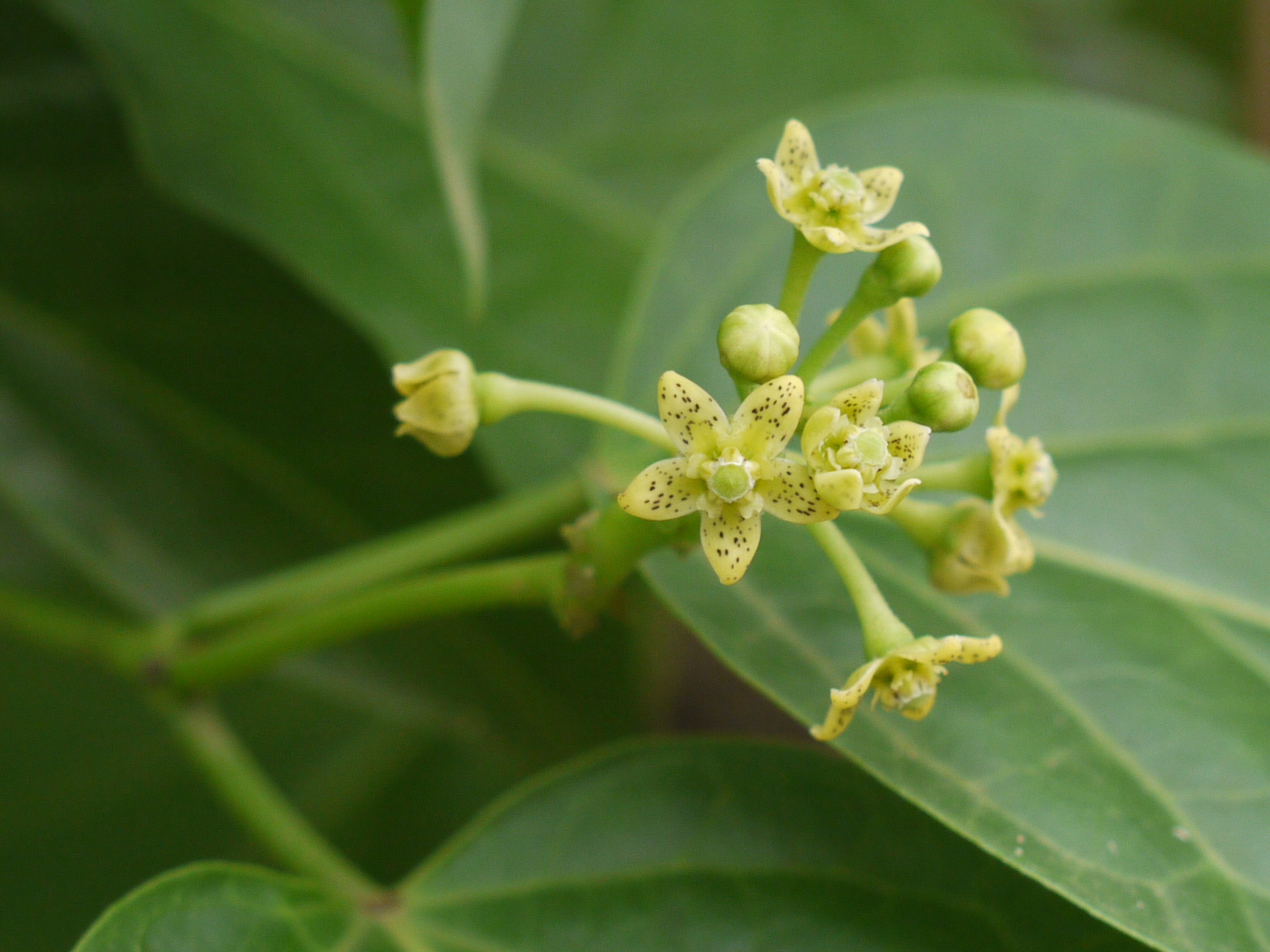
KOZ-moh-STIG-muh -- Greek: kosmos (ornament); stigma, which in botany refers to the receptive tip of a carpel ... compiled from the web
kor-DAY-tum -- heart-shaped, referring to leaves ... Dave's Botanary
commonly known as: green milkweed creeper • Gujarati: શેંદવેલ shendvel • Kannada: ಘರ ಹೂವು ಗಿಡ ghara hoovu gida • Konkani: बैल दोडकी bail dodki, घारफुली gharphuli, मरोय maroy, सूतकांती sutakanti • Malayalam: വട്ടോളം vattolam, വട്ടുവള്ളി vattuvalli • Marathi: जटी jati, मारवेल marvel, शेंडवेल shendvel • Mundari: जटी jati • Tamil: கருத்தங்கண்ணி karuththangkanni, பெரும் காகமுகன் கொடி perum kaakamugan kodi • Telugu: అడవి తమలపాకు adavi tamalapaaku • Tulu: ಮಲ್ಲ ಪೆತ್ತತಜಂಕ್ malla petthathajanku, ಮಿರೆ ಬಾಪುಥ ತಪ್ಪು mire baaputha thappu, ಪೇರ್ ಕುಜುಂಬೆ peru kujumbe
known for / parts made use of: the leaves and roots (medicinal) ... compiled from the web.
botanical names: Cosmostigma cordatum (Poir.) M.R.Almeida ... homotypic synonyms: Periploca cordata Poir. ... heterotypic synonyms: Asclepias racemosa Roxb. • Cosmostigma racemosum Wight ... and more at POWO, retrieved August 16, 2026
known for / parts made use of: the leaves and roots (medicinal) ... compiled from the web.
Bibliography / etymology / notes
Links listed as references in the notes below, may not remain valid permanently. Portals / websites have a tendency to re-organize / revise their content, leading to change in URLs of pages in their site. Some sites may even close down at their own will. The bits about the languages of India mentioned below are merely some bare facts gathered from the internet; just enough to satisfy curiosity about "where" could the listed names be best prevalent in India. All English transliterated names to be taken sensu amplo.
~~~~~ ENGLISH ~~~~~
written and spoken widely, in most parts of India
green milkweed creeper
- Flowers of India ... (accessed: August 15, 2026)
~~~~~ GUJARATI ~~~~~
written in: Gujarati (ગુજરાતી) ... spoken in: Gujarat, Dadra & Nagar Haveli, Daman & Diu
શેંદવેલ shendvel
- for Cosmostigma racemosum Wight ... વનસ્પતીઓ ના ગુજરાતી તથા બોટનીકલ નામ ની યાદી :: સંકલન કર્તા વૈધ શ્રી કે,જે,ઝાલા ... (downloaded: 19 Jan 2026)
- This name શેંદવેલ shendvel is an exact cognate of the Marathi Shendvel (शेंडवेल). It translates directly to "The vine with trailing top-shoots", describing the way its young tendrils stretch out over forest canopies. ... compiled from the web.
~~~~~ KANNADA ~~~~~
written in: Kannada (ಕನ್ನಡ) ... spoken in: Karnataka
ಘರ ಹೂವು ಗಿಡ ghara hoovu gida
- for Cosmostigma racemosum Wight ... Subrahmanya, Prasad K - Exploration and elucidation of traditional medicinal plants of erstwhile Tulunadu and surrounding area of Kerala and Karnataka :: Chapter 4 :: Shodhganga - a reservoir of Indian theses @ INFLIBNET
- for Cosmostigma racemosum Wight ... S G Narsimhachar - Latin and Kannada names of indigenous and medicinal plants of Mysore - Mandayam Digital Library ... (downloaded: Nov 27, 2020)
- ಘರ (Ghara) – meaning "house"; ಹೂವು (Hoovu) – meaning "flower"; ಗಿಡ (Gida) – meaning "plant" or "shrub". The name literally tanslates to "House Flower Plant". ... compiled from the web.
~~~~~ KONKANI ~~~~~
written in: Devanagari (कोंकणी) / Kannada (ಕೊಂಕಣಿ) / Malayalam (കൊങ്കണി) / Perso-Arabic (کونکنی) / Romi (Konknni) ... spoken in: Goa, Karnataka, Maharashtra, Kerala, Gujarat
बैल दोडकी bail dodki, घारफुली gharphuli, मरोय maroy, सूतकांती sutakanti
- for Cosmostigma racemosum Wight ... Dalgado, Daniel Gelanio. Flora de Goa e Savantvadi: catalogo methodico das plantas medicinaes, alimentares e industriaes. Portugal, Imprensa Nacional, 1898. ... (downloaded: 21 Sept 2020)
- for Cosmostigma racemosum Wight ... V D Vartak (1966) - Enumeration of plants from Gomantak India with a note on botanical excursions to the Castlerock area :: Chapter 5 :: Shodhganga :: a reservoir of Indian theses @ INFLIBNET
- बैल दोडकी (Bail dodki) — While the domestic दोडकी (dodki = Ridge Gourd) is a tender kitchen vegetable, Cosmostigma cordatum (syn. C. racemosum) is a wild forest climber of the milkweed family (Apocynaceae) that exudes a thick, bitter, milky sap. The plant produces massive, thick, oblong, pale-green pods (follicles) that grow in pairs. When hanging from the forest canopy, these large, blunt, ribbed pods look strikingly similar to stocky ridge gourds.In Indian folk botany, prefixes like "बैल" (Bail = Bullock) or "रान" (Ran = Wild) are systematically applied to plant names to signify two key traits: "massive scale" or "inedibility". Labeling this species "बैल दोडकी" serves as an ecological warning to the community that this is a tough, wild gourd-lookalike meant strictly for external medicinal applications, rather than the human cooking pot. ... compiled from the web.
- घारफुली (Gharphuli) is likely a descriptive folk name based on the plant's growth habit and appearance. In both Konkani and Marathi, घार (Ghar) means a "Kite" (the predatory bird known for soaring at impressive heights), while फुली (Phuli) means "blooming" or "flowering." The name loosely translates to "Kite Flower", referencing the plant's vigorous, high-climbing nature as it scales tall forest trees. ... compiled from the web.
- The name मरोय maroy stems directly from the foundational Konkani and Marathi root verb मुरडणे (Muradane) or मरोडणे (Marodane), which means "to twist," "to twine," "to turn," or "to wring." When a root verb transitions into a colloquial Konkani noun to describe a forest vine, it shifts phonetically into मरोय (Maroy), translating literally to "The Twisted One" or "The Twister Vine". ... compiled from the web.
- सूत (Suta) = "thread", "silk" or "yarn"; कांती (Kanti) = "brilliance", "lustre", "glowing beauty" or "aura"."Sutakanti" literally translates to "The Glowing Thread". When the large pods of Cosmostigma cordatum split open in the winter sun, hundreds of seeds escape into the wind. Each individual seed is crowned with a dense, shimmering, snow-white tuft of long, silky hairs. As they catch the sunlight and drift through the forest canopy, they do not just look like random fluff — they literally glow with a brilliant, silky lustre. ... compiled from the web.
~~~~~ MALAYALAM ~~~~~
written in: Malayalam (മലയാളം) ... spoken in: Kerala, Lakshadweep
വട്ടോളം vattolam, വട്ടുവള്ളി vattuvalli
- വിക്കിപീഡിയ - സ്വതന്ത്രസർവ്വവിജ്ഞാനകോശം ... Wikipedia - The Free Encyclopedia ... (accessed: August 16, 2026)
- വട്ടം (Vattam) — meaning "circle", "round" or "circular"; ഓല (Ola) / ഇല (Ila) — meaning "Leaf". The name literally translates to "Round Leaf" implying "Round-leaved Plant". ... compiled from the web.
- വട്ടു (Vattu) is a colloquial variation of the root word വട്ടം (Vattam), which means "circle", "round" or "circular". വള്ളി (Valli) is the native Malayalam word, while വല്ലീ (Valli) — the Sanskritized/Classical variant; "Valli" means a creeping/climbing plant. Thus literally translating to "Round-leaved Climber". ... compiled from the web.
~~~~~ MARATHI ~~~~~
written in: Devanagari (मराठी) ... spoken in: Maharashtra, Karnataka
जटी jati
- Many thanks to Swagat Thorat for help with this name ... eFloraofIndia
- जटी jati — derived as a smaller, diminutive version of जटा (Jata), meaning "matted hair". This is a direct native reference to the plant's flat seeds, which are attached to dense, silky white hair tufts (comose seeds) that resemble tiny locks of hair when the seed pods split open.
HISTORICAL VARIANTS IN LITERATURE
The 1887 BNHS Record: जती (Jati) — The British recorded it phonetically as "Jati". Lacking Devanagari script markers, later editors back-translated the soft English "t" into a Marathi त instead of the correct retroflex ट. ... compiled from the web.
The Government Gazetteer Record: जाती (Jati) — A later hyper-correction. Editors assuming "जती" was a typo for the well-known word "जाती" (class/species/wild jasmine) elongated the vowel to make it look grammatically standard in text. ... compiled from the web.
मारवेल marvel (or मारवेळ maravel), शेंडवेल shendvel (or शेंडवल shendval)
- FRLHT's ENVIS Centre on Medicinal Plants ... (accessed: August 16, 2026)
- Date, Yasavanta Ramakrshna. Maharashtra sabdakosa. Pune: Maharashtra Kosamandala, 1932-1950.
- Molesworth, J. T. (James Thomas). A dictionary, Marathi and English. 2d ed., rev. and enl. Bombay: Printed for government at the Bombay Education Society's press, 1857.
- In coastal Maharashtra, माड (Mad) specifically means a palm tree (or colloquially, any tall tree). Heavy, woody climbers like Cosmostigma cordatum grow by forcefully winding around tree trunks to reach the forest canopy. In local dialects, a vine that aggressively climbs high onto a Mad or a tree top is referred to as a माड-वेल (Mad-vel), which phonetically evolved and smoothed out over generations into मारवेल (Marvel) or मारवेळ (Marvel). ... compiled from the web.
- शेंडा (Shenda) — meaning the "topmost shoot", "tip", "apex" or "trailing sprout" of a plant; वेल (Vel) — meaning a "climbing vine" or "creeper". "Shendvel" literally translates to "The creeper with prominent/extensive trailing top-shoots". This is highly accurate for Cosmostigma, which launches long, leafless, twining tendril-tips high into the forest canopy before the foliage completely unravels. ... compiled from the web.
~~~~~ MUNDARI ~~~~~
written in: Mundari Bani, Odia, Devanagari, Bengali, Latin ... spoken in: Jharkhand, Odisha
जटी jati
- for Cosmostigma racemosum Wight ... Das, Prabhat & Das, Mohini & Sahu, Chinmayee & Rath, Sakti & Kumar, Sanjeet. (2020). Diversity of Climbers of Odisha ... (downloaded: Dec 22, 2021)
- जटी Jati — Finding the name Jati used by the Munda tribe of Odisha provides a breathtaking cross-continental link. It perfectly mirrors the true native field name जटी (Jati) used by the forest-dwelling communities of Maharashtra. This demonstrates that across different language families and geographic divides, the plant's distinctive visual traits — namely its deeply matted, rope-like climbing habits or its hair-tufted, silky seed bundles—inspired tribal communities across India to independently use the exact same linguistic descriptor. ... compiled from the web.
~~~~~ TAMIL ~~~~~
written in: Tamil (தமிழ்) ... spoken in: Tamil Nadu, Puducherry, Andaman & Nicobar Islands
கருத்தங்கண்ணி karuththangkanni, பெரும் காகமுகன் கொடி perum kaakamugan kodi
- for Cosmostigma racemosum Wight ... Yercaud Ilango - Tamil names of Botanical names ... (downloaded: Jun 23, 2022)
- கருத்தங்கண்ணி (Karuththangkanni) — This name translates conceptually to "The Highly Potent/Curing Twining Vine". It combines கருத்தம் (Karuththam), referencing intense therapeutic value or medical focus, with கண்ணி (Kanni), which signifies a looping garland or climbing vine. In regional Siddha medicine, this name highlights the creeper's reputation as a highly valued, essential remedy for healing chronic wounds, ulcers, and internal digestive disorders. ... compiled from the web.
- பெரும் காகமுகன் கொடி (Perum kaakamugan kodi) — Visually spectacular, this name translates literally to "The Large Crow-Beaked Vine". It is a compound of பெரும் (Perum = Large), காகமுகன் (Kaakamugan = Crow-faced or Crow-beaked), and கொடி (Kodi = Climber). This name is an artistic visual descriptor of the plant's massive, paired seed pods. As they hang in tandem from forest canopies, these thick, oblong, and slightly curved follicles taper sharply at the apex, looking exactly like the prominent, curved beak of a large crow. ... compiled from the web.
~~~~~ TELUGU ~~~~~
written in: Telugu ( తెలుగు) ... spoken in: Andhra Pradesh, Telangana, Puducherry
అడవి తమలపాకు adavi tamalapaaku
- for Cosmostigma racemosum Wight ... Herbarium JCB - Flora of Peninsular India ... (accessed: August 18, 2026)
- అడవి తమలపాకు (Adavi Tamalapaaku) — Derived from అడవి (Adavi = wild) and తమలపాకు (Tamalapaaku = betel leaf), this name translates literally to "The Wild Betel Leaf". It is a vivid morphological descriptor based on the plant's wide, glossy, heart-shaped leaves and twining climbing habit, which look remarkably identical to the cultivated betel vine (Piper betle) when viewed stretching across forest canopies. Labeling it "అడవి" (Wild) warns locals that despite the uncanny visual resemblance to their favorite kitchen leaf, this forest vine yields a completely different, highly potent medicinal profile and a milky sap. ... compiled from the web.
~~~~~ TULU ~~~~~
written in: Tigalari (Tulu) was used for writing Vedic texts in Sanskrit, Kannada (ತುಳು), Malayalam (തുളു) ... spoken in: Karnataka, north Kerala
ಮಲ್ಲ ಪೆತ್ತತಜಂಕ್ malla petthathajanku, ಮಿರೆ ಬಾಪುಥ ತಪ್ಪು mire baaputha thappu
- for Cosmostigma racemosum Wight ... Subrahmanya, Prasad K - Exploration and elucidation of traditional medicinal plants of erstwhile Tulunadu and surrounding area of Kerala and Karnataka :: Chapter 4 :: Shodhganga - a reservoir of Indian theses @ INFLIBNET
- ಮಲ್ಲ ಪೆತ್ತತಜಂಕ್ (Malla petthathajanku) — A compound of ಮಲ್ಲ (Malla = Large) and ಪೆತ್ತತಜಂಕ್ (Petthathajanku = Cattle Herb). In Tulu folklore, Petthathajanku is strictly the name for Wattakaka volubilis, so named because its leaves are traditionally applied to treat yoke-ulcers on the shoulders of cattle (Pettha). Because Cosmostigma cordatum belongs to the same family and exhibits identical climbing features but showcases significantly larger leaves and fruit structures, local foragers naturally designated it as ಮಲ್ಲ ಪೆತ್ತತಜಂಕ್, meaning "The Larger Wattakaka". ... compiled from the web.
- ಮಿರೆ ಬಾಪುಥ ತಪ್ಪು (Mire baaputha thappu) — ಮಿರೆ (Mire = Udder/Breast) + ಬಾಪುಥ (Baaputha = Relating to swelling/inflammation) + ತಪ್ಪು (Thappu = Leaf). Translating literally to "The Leaf for Udder Swelling", this name completely bypasses the plant's visual traits to highlight its vital role in traditional veterinary medicine. In the coastal dairy communities of Tulunadu, the thick leaves of this climber are crushed into a potent medicinal paste and applied externally to treat mastitis (udder inflammation) in cattle — acting as a fast-acting, anti-inflammatory poultice to reduce swelling and ease the animal's pain. ... compiled from the web.
ಪೇರ್ ಕುಜುಂಬೆ peru kujumbe
- Karnataka Biodiversity Board, 2019. FLORA OF KARNATAKA, A Checklist, Volume – 2: Gymnosperms and Angiosperms. 1 - 1002 (Published by Karnataka Biodiversity Board) ... (downloaded: Oct 4, 2020)
- ಪೇರ್ ಕುಜುಂಬೆ (Peru kujumbe) — ಪೇರ್ (Peru = Milk/Milky Sap) + ಕುಜುಂಬೆ (Kujumbe = Tangled cluster/clump). Translating literally to "The Milky Tangled Vine", this name perfectly describes two core traits of the species. The prefix Peru marks its family membership as a producer of copious, sticky white latex, while Kujumbe graphically details its growth habit in the wild, where the heavy stems twist intricately into dense, knotted, rope-like clumps across forest thickets. ... compiled from the web.
~~~~~ KNOWN DISTRIBUTION in INDIA ~~~~~
Andhra Pradesh, Goa, Gujarat, Karnataka, Kerala, Maharashtra, Odisha, Tamil Nadu
- Hassler, Michael (1994 - 2026): World Plants. Synonymic Checklist and Distribution of the World Flora. Version 26.08; last update Aug. 2nd, 2026. Last accessed 16/08/2026 (dd/mm/yyyy).
~~~~~
Created on: 13:33 16-08-2026 ¦ Last updated: 17:41 18-08-2026 (DD-MM-YYYY)
~~~~~
.


No comments:
Post a Comment