
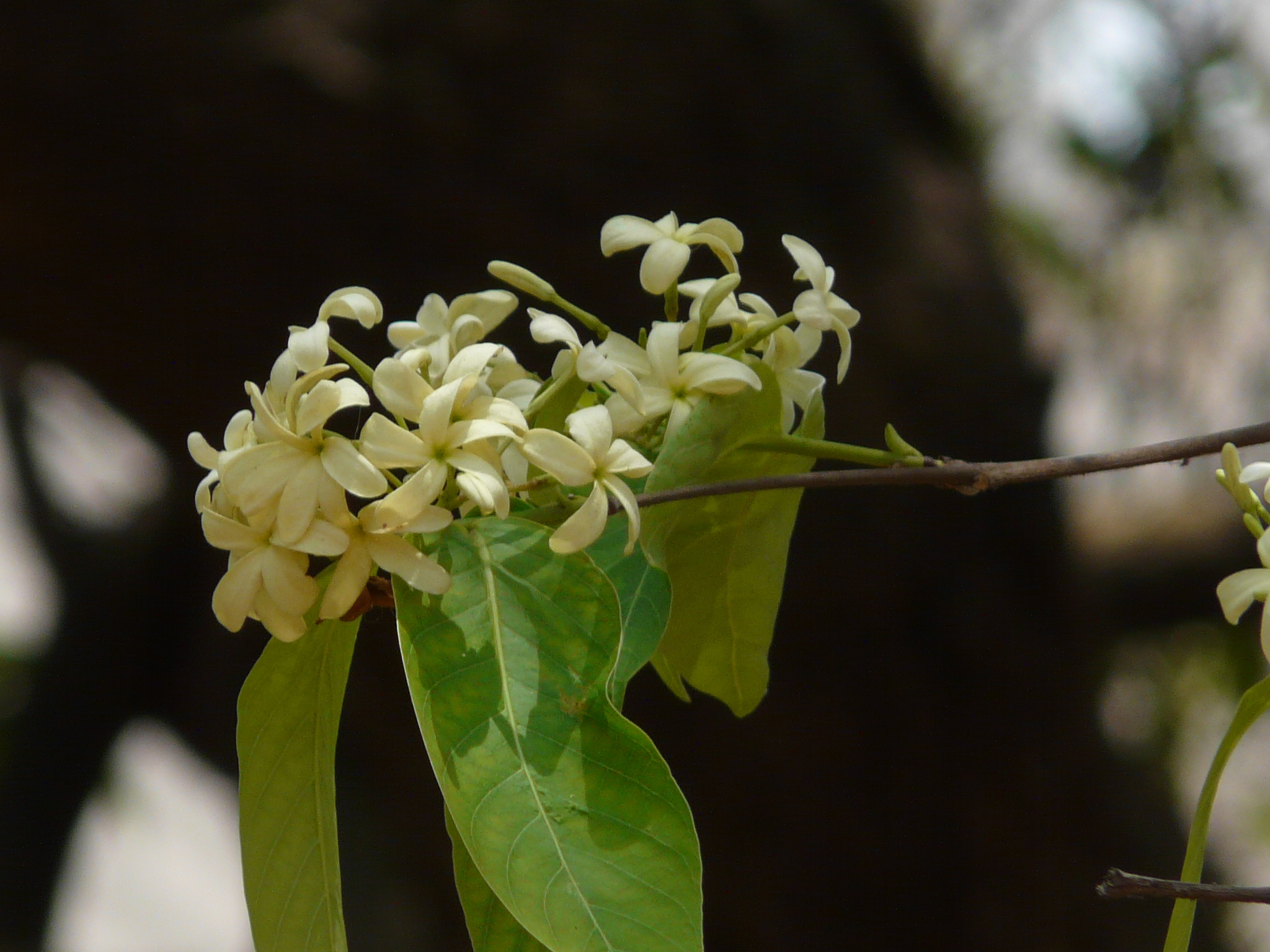
ho-lar-REN-uh -- Greek: holos (whole, entire); arrhen (male); all anthers are fertile ... Dave's Botanary
pew-BES-senz or pub-ess-ens -- downy, short haired ... Dave's Botanary
commonly known as: bitter oleander, conessi bark, Easter tree, ivory tree, kurchi bark, Tellicherry tree • Arabic: اندرجو تلخ / إندر جاو تلخ inderjao talkh, لسان العصافير المرّ lasanul-aasafirul-murr • Assamese: দুধখুৰী dudkhuri, ধুতখুৰী dhutkhuri • Bengali: ইন্দ্রযব indrajab, কুড়চি kurchi, কুটজ kutaja • Bhojpuri: दुधकोरिया dudhkoria • Bodo: doukhri • Dogri: इंद्र जौ indra jau, कोगढ़ kogad • Garo: bol-matra, bolmigmu, mat-mande • Gujarati: ધોવડા કુડા dhowda kuda, ઈંદ્રજવ indrajav, કડો kado, કારીખડો kaarikhado • Hajong: dudkurchi • Haryanvi: दुधी dudhi, कुर्ची kurchi • Hindi: दूधी dudhi, इंद्रजव indrajav, कुर्ची kurchi, कुटज kutaj, क्वेरा kwera • Jharua: দুধখুৰী dudkhuri • Kachari: khiloshi-jalla-phang, kholoshiphang-jola • Kachchhi: કડવો ઈંદ્રજવ kadvo indrajav • Kannada: ಕೊಡಸಿಗೆ kodasige, ಕೊಡುಮುರುಕು ಗಿಡ kodumuruku gida, ಕೊರಸಿಗ korasiga, ಕುಡ್ಸಾಲು kudsaalu • Karbi: bengol-arong, bengoy-the-arong, bing-wai-pi-arong, theng-lokso • Kashmiri: अन्दुसुरुन् andusurun • Khasi: dieng-jameu, dieng-lakhiet-dkhar, dieng-pang-knai, dieng-pankanaisynrang • Kokborok: kuchimavompang • Kol: गोतेक gotek, हात hat, कुआर kuar, तुआर tuar • Konkani: धवो कुडो dhavo kudo, कुडो kudo • Kuki: leng-wom-theng • Kumaoni: कुड़ा kura • Kurukh: कोरकोरिया korkoria • Lepcha: ᰑᰈᰬᰛᰧᰎ fajeerip • Magadhi: दुधकोरिया dudhkoria • Maithili: दुधियारी dudhiari • Mal Pahariya: कुरदू kurdu • Malayalam: കുടകപ്പാല kudakappaala • Mandeali: केओर keor, कुर्ची kurchi • Manipuri: ꯀꯨꯔꯆꯤ কুরচি kurchi • Marathi: इंद्रजव indrajav, कुटज kutaja, पांढरा कुडा pandhra kuda • Mizo: thlengpa • Nagpuri: कोरैया koraiya • Nepali: बन खिर्रो ban khirro, इन्द्रजौ indrajau, मदिसे खिर्रो madise khirro • Odia: ଭଦ୍ର ଯବ bhadra jaba, କଲବିଙ୍କ kalabinka, କେରୁଆ kerua, କୁର୍ଚ୍ଚି kurchi, କୁରେଇ kurei, ମୁଣ୍ଡିଆ କୋରୁଆଁ mundia koruan, ପାଣ୍ଡୁର ଦ୍ରୁମ pandura druma, ପୀତ କାବେର pita kabera, ଶକ୍ର ପୁଷ୍ପ shakra pushpa • Pahari: दूधी dudhi, इंद्रजौ indrajau, करची karchi, कर्रा karra, केओर keor, कोरा kora, कुआर कुरेया kuar kureya, कुची kuchi, कुड़ा kura, कुरसी kursi • Persian: اندرجو تلخ indar-jave-talkh, تخم احار تلخ tukhme-ahare-talkh, زبان گنجشک تلخ zabane-kunjashke-talkh • Punjabi: ਕੇਵਰ kewar, ਤਿਵਾਜ tiwaj • Rabha: dudkurchi • Rajasthani: दुधी कड़वाला dudhi karvala • Sanskrit: अम्बिका ambika, भद्रज bhadraja, भद्रयव bhadrayava, गिरिमल्लिका girimallika, इन्द्रयव indrayava, काही kahi, कलिङ्ग kalinga, कौट kauta, कोहिन् kohin, कूटज kutaja, महागन्ध mahagandha, पाण्डुरद्रुम panduradruma, प्रावृष्य pravrshya, सङ्ग्राहिन् sangrahin, शक्र shakra, शक्राह्य shakrahya, शक्रपर्याय shakraparyaya, शनपर्णी shanaparni, वरतिक्त varatikta, वत्साह्वय vatsahvaya, वत्सक vatsaka, वृन्तिता vrntita, यवफल yavaphala • Santali: ᱦᱟᱴ hat • Tamil: அருளரசி arularaci, இந்திரபம் intirapam, இந்திரியவம் intiri-yavam, கசப்புவெட்பாலை kacappu-vetpalai, கலிங்கம் kalinkam, கவுபதம் kavupatam, கிரிமல்லிகை kirimallikai, குடசப்பாலை kutaca-p-palai, குடப்பாலை kutappalai, பலம் palam, பூதகேசரி putakecari, வத்தகம் vattakam, வற்சம் vaṟcam, வேப்பாலை veppalai • Telugu: చేదుకొడిసె chedukodise, గిరిమల్లిక girimallike, ఇంద్రవృక్షము indravrakshamu, కళింగము kalingamu, కొడిసెపాల kodisepala, కొడిసెవిత్తులు kodisevittulu, కోలముక్కి చెక్క kola-mukki-chekka, కుటజము kutajamu, మనుపాల manu-pala • Tibetan: དུག་མོ་ཉུང tug-mo-nyung • Tulu: ಕೊಡಗಾಸನ kodagasana, ಕೊಡೆಂಚಿ kodenchi • Urdu: کٿج kutaj
known for / parts made use of: stem bark, root bark, seeds and minor use of leaves and flowers ... compiled from the web
botanical names: Holarrhena pubescens Wall. ex G.Don ... heterotypic synonyms: Echites antidysentericus Roth • Holarrhena antidysenterica (G.Don) Wall. ex A.DC. ... and more at POWO, retrieved September 09, 2026
known for / parts made use of: stem bark, root bark, seeds and minor use of leaves and flowers ... compiled from the web
Bibliography / etymology / notes
Links listed as references in the notes below, may not remain valid permanently. Portals / websites have a tendency to re-organize / revise their content, leading to change in URLs of pages in their site. Some sites may even close down at their own will. The bits about the languages of India mentioned below are merely some bare facts gathered from the internet; just enough to satisfy curiosity about "where" could the listed names be best prevalent in India. All English transliterated names to be taken sensu amplo.
~~~~~ ENGLISH ~~~~~
written and spoken widely, in most parts of India
bitter oleander
- The Botanical Dermatology Database by John Mitchell & Arthur Rook ... (accessed: September 11, 2026)
- The "Oleander" Reference: The plant belongs to the Apocynaceae family, which also includes the true European Oleander (Nerium oleander). Because Holarrhena pubescens features clusters of white flowers, milky white sap, and elongated seed pods that closely resemble the true oleander, British observers named it based on visual similarity. ... compiled from the web.
- The "Bitter" Modifier: In local tongues, the plant's medicinal seeds are known for their incredibly sharp, bitter taste (reflected in the Hindi name Indrajau Kadva, where kadva translates directly to bitter). The English name simply translated this primary physical and therapeutic characteristic. ... compiled from the web.
conessi bark
- for Holarrhena antidysenterica (G.Don) Wall. ex A.DC. ... Dalgado, Daniel Gelanio. Flora de Goa e Savantvadi: catalogo methodico das plantas medicinaes, alimentares e industriaes. Portugal, Imprensa Nacional, 1898. ... (downloaded: 21 Sept 2020)
- University of Madras. Tamil lexicon. [Madras], University of Madras, 1924-1936.
- for Holarrhena antidysenterica (G.Don) Wall. ex A.DC. ... Sir George Watt - A Dictionary of the Economic Products of India - Volume 1
- for Holarrhena antidysenterica (G.Don) Wall. ex A.DC. ... The Useful Plants of India (CSIR, Publications & Information Directorate)
CONESSI — AN EXCLUSIVE EXONYM (A NAME USED ONLY BY OUTSIDERS)
The term "Conessi" — most widely recognized in historical pharmaceutical literature as "Conessi bark" — presents a fascinating case of linguistic evolution. While many modern digital databases and botanical indices casually catalog "Conessi" as a native Tamil or Malayalam name, the word itself does not exist in standard South Asian vernacular lexicons. Instead, it is a colonial "ghost word" — a European trade exonym born from centuries of phonetic distortion.
The word "Conessi" will not be found as an active entry in authoritative South Asian dictionaries. For instance, in the multi-volume University of Madras Tamil Lexicon, "Conessi bark" is utilized strictly within the English definitions to explain authentic native terms.
In Tamil tradition, local merchants, indigenous physicians (Siddhars and Vaidyas), and native trade publications never adopted the term "Conessi". South Asian botanical systems already possessed a highly precise, descriptive vocabulary based on the tree’s physical traits. There was zero functional reason for them to adopt a foreign mispronunciation.
Instead, "Conessi" was strictly an administrative and export label. In the 16th and 17th centuries, Portuguese traders on the Malabar Coast documented the medicinal tree Holarrhena antidysenterica by phonetically recording its local Malayalam name, Kodagapala, as Codaga pala or Corte-de-pala. When British and French East India Company physicians later adopted the drug, generations of handwritten shipping manifests, mishearings, and anglicisation gradually corrupted Codaga into Cavessi, Conessie, and ultimately Conessi.
"Conessi" is thus an extreme linguistic distortion filtered through Portuguese, French, and British commercial records. When modern archival texts state that "Conessi is a Tamil name", it is an indexing shortcut. The accurate relationship is inverse: "Conessi" was the Western export trade name for the drug.
While this historical trade name is no longer prevalent in the active, mainstream Indo-European commercial pharmaceutical market, it has not vanished entirely. It maintains an active presence today in global herbal trade nomenclature, historical pharmacopoeias, and niche global e-commerce platforms — keeping the legacy of this linguistic ghost word alive.
Easter tree (typographic variant: ester tree)
- Rathinaraj, Pauline & Waller, Ridling. (2007). The Easter Tree - Holarrhena antidystenterica. ... (accessed: September 11, 2026)
- The Pitchandikulam Forest Virtual Herbarium Auroville Virtual Herbarium ... (accessed: September 11, 2026)
- Umrao Singh, A M Wadhwani, B M Johri - Dictionary of Economic Plants in India - Second Edition 1983, Indian Council of Agricultural Research, New Delhi
MUCH ADO ABOUT "EASTER TREE"
"Easter Tree" is the meaningful common name. It is called this because the tree bursts into a beautiful canopy of snowy-white flowers right around April, perfectly coinciding with the Easter season. "Ester Tree" is actually a widely circulated typographical error. more of a phonetic spelling of "Easter". Over time, this typo was copied across several online Indian plant databases, botanical lists, and regional forestry logs, accidentally establishing it as a "variant" name. The name "Easter tree" is widely documented in botanical and trade databases in India, but it is not popular or prevalent in daily, colloquial conversation among the general public. ... compiled from the web.
When modern urban Indians use the phrase "Easter tree", they are usually referring to an entirely different plant: Wrightia antidysenterica (commonly known as the Arctic Snow, Milky Way, or Sri Lankan Wrightia). Unlike Holarrhena pubescens (earlier popularly known as Holarrhena antidysenterica), Wrightia antidysenterica does not bloom specifically for the Easter season. It blooms non-stop, all year round. It carries the label "Easter Tree" because of identity theft! In early botanical history, Holarrhena pubescens and Wrightia antidysenterica were heavily confused by European botanists. They belong to the same family, look almost identical when looking at just the white flowers, and were both used to treat dysentery. Because of this intense taxonomic confusion, the common name "Easter tree" got accidentally mapped onto Wrightia in commercial trade and local nurseries. ... compiled from the web.
ivory tree
- Grow Billion Trees - Kurchi Tree (Ivory Tree): India's Forgotten Healing Gem ... (accessed: September 11, 2026)
- Umrao Singh, A M Wadhwani, B M Johri - Dictionary of Economic Plants in India - Second Edition 1983, Indian Council of Agricultural Research, New Delhi
IVORY TREE: A SHARED MONOPOLY
"Ivory Tree" — It is widely documented in official Indian botanical databases for Holarrhena pubescens, but it is not popular or prevalent in daily, colloquial speech. It is heavily shared with at least two other trees in India, often causing confusion. As such, Wrightia tinctoria is the definitive "ivory wood tree" due to its well-known use by Indian artisans since historic times, in making the world-famous, lacquer-painted Channapatna toys in Karnataka. Both species belong to same family, look nearly identical, and share habitats, therefore the name "ivory tree" is constantly swapped between them in trade lists. ... compiled from the web.
Other tree is Wrightia antidysenterica. Historically, early European botanists genuinely considered W. antidysenterica and H. antidysenterica to be the same plant or direct synonyms. Due to this accidental synonymy, their popular trade names got cross-referenced in early trade journals.
kurchi bark
- Gjerstad, G., & Modak, A. (1968). Kurchi Bark (Cortex Holarrhenae antidysentericae) A Drug of Great Therapeutic Potential. Quarterly Journal of Crude Drug Research, 8(4), 1141–1151. ... (accessed: September 11, 2026)
- The popularity of the name "Kurchi" in the English language is a direct result of British colonial trade, botanical exploration, and the global spread of tropical medicine during the 18th and 19th centuries. "Kurchi" (sometimes spelled kurchee) is a direct phonetic loanword taken from local Indian languages, primarily Hindi (कुर्ची) and Bengali (কুড়চি). According to historical lexicographers like those at Merriam-Webster, the vernacular name likely traces back much further to the Sanskrit root word kūrca, which translates to a "bunch", "bundle", or "brush" — likely a reference to the characteristic appearance of the tree's dense tufts of white flowers or its bundled bark. ... compiled from the web.
Tellicherry tree (trade name: Tellicherry bark)
- Flowers of India ... (accessed: September 09, 2026)
- for Holarrhena antidysenterica (G.Don) Wall. ex A.DC. ... The Useful Plants of India (CSIR, Publications & Information Directorate)
- "Tellicherry bark" — This name links the plant directly to a historical geography. Tellicherry (now known as Thalassery), located on the Malabar Coast of Kerala, India, was a major British East India Company trading post. The bark harvested from this region was considered to be of exceptionally high medicinal quality and was heavily traded from this port. For global merchants and British physicians, the medicine simply became known by the port it sailed out of: "the bark from Tellicherry". While the tree produces medicinal seeds (known as Indrayava in Sanskrit), the primary, most potent part of the plant used to combat tropical diseases is its bitter outer bark. ... compiled from the web.
~~~~~ ARABIC ~~~~~
written in: Arabic (عَرَبِيّ) ... spoken in: various states of India ... Wikipedia
اندرجو تلخ / إندر جاو تلخ inderjao talkh, لسان العصافير المرّ lasanul-aasafirul-murr
- FRLHT's ENVIS Centre on Medicinal Plants ... (accessed: September 16, 2026)
- Khan, Shayni & Viquar, Professor & Alam, Md Aftab & Moin, Md Sanaul & Khatoon, Faiza & Minhajuddin, Ahmed. (2021). International Journal of Botany Studies - Ethno-pharmacology of Holarrhena antidysenterica Wall.ex G.Don (Tewāj) in light of Unani System of Medicine. ... (accessed: September 17, 2026)
~~~~~ ASSAMESE ~~~~~
written in: Assamese (অসমীয়া) ... spoken in: Assam, Arunachal Pradesh, Meghalaya
দুধখুৰী dudkhuri, ধুতখুৰী dhutkhuri
- for Holarrhena antidysenterica (G.Don) Wall. ex A.DC. ... U N Kanjilal, P C Kanjilal, A Das, R N De - Flora of Assam - Vol III
- for Holarrhena antidysenterica (G.Don) Wall. ex A.DC. ... The Useful Plants of India (CSIR, Publications & Information Directorate)
~~~~~ BENGALI ~~~~~
written in: Bengali (বাংলা) ... spoken in: West Bengal, Assam, Jharkhand, Tripura, Andaman & Nicobar Islands
ইন্দ্রযব indrajab, কুটজ kutaja
- for Holarrhena antidysenterica (G.Don) Wall. ex A.DC. ... Dasa, Jnanendramohana. Bangala bhashara abhidhana. Paribarttita o paribardhita 2. samskarana. Kalikata: Indiyan Pablisim Hausa, [bhumika 1937] 2 v.
কুড়চি kurchi
- for Echites antidysentericus Roth ... Dasa, Jnanendramohana. Bangala bhashara abhidhana. Paribarttita o paribardhita 2. samskarana. Kalikata: Indiyan Pablisim Hausa, [bhumika 1937] 2 v.
- for Holarrhena antidysenterica (G.Don) Wall. ex A.DC. ... PRAIN, DAVID - BENGAL PLANTS - VOL. II
- for Holarrhena antidysenterica (G.Don) Wall. ex A.DC. ... The Useful Plants of India (CSIR, Publications & Information Directorate)
~~~~~ BHOJPURI ~~~~~
written in: Devanagari (भोजपुरी) ... spoken in: eastern Uttar Pradesh, western Bihar and northwestern Jharkhand
दुधकोरिया dudhkoria
- Floristic Diversity of Aurangabad - बिहार वानिकी विकास निगम लिमिटेड (Bihar Forestry Development Corporation Limited) ... (downloaded: December 31, 2023)
- Floristic Diversity of Kaimur - बिहार वानिकी विकास निगम लिमिटेड (Bihar Forestry Development Corporation Limited) ... (downloaded: December 31, 2023)
- Floristic Diversity of Rohtas - बिहार वानिकी विकास निगम लिमिटेड (Bihar Forestry Development Corporation Limited) ... (downloaded: December 31, 2023)
- Floristic Diversity of Udaipur - बिहार वानिकी विकास निगम लिमिटेड (Bihar Forestry Development Corporation Limited) ... (downloaded: December 31, 2023)
- Floristic Diversity of West Champaran - बिहार वानिकी विकास निगम लिमिटेड (Bihar Forestry Development Corporation Limited) ... (downloaded: December 31, 2023)
~~~~~ BODO ~~~~~
written in: Devanagari or Latin ... spoken in: Assam ... other names for this language: Boro
doukhri
- Deka, Dipali (2007) - Ethno medico botanical study of certain tribes of Goalpara district, Assam :: Chapter 5 - Shodhganga :: a reservoir of Indian theses @ INFLIBNET
~~~~~ DOGRI ~~~~~
written in: Devanagari (डोगरी) ... spoken in: Jammu & Kashmir ... spoken by the Dogras
इंद्र जौ indra jau, कोगढ़ kogad
- Many thanks to OM Prakash Vidyarthi for help with these names ... facebook
~~~~~ GARO ~~~~~
written in: Roman, Bengali-Assamese, A-Chik Tok'birim ... spoken in: Meghalaya, Assam
bol-matra, bolmigmu, mat-mande
- for Holarrhena antidysenterica (G.Don) Wall. ex A.DC. ... U N Kanjilal, P C Kanjilal, A Das, R N De - Flora of Assam - Vol III
- for Holarrhena antidysenterica (G.Don) Wall. ex A.DC. ... Mrigen Das (2007) - Ethnobotany of Garo tribe of Bongaigaon district, Assam :: Chapter 7 - Shodhganga :: a reservoir of Indian theses @ INFLIBNET
~~~~~ GUJARATI ~~~~~
written in: Gujarati (ગુજરાતી) ... spoken in: Gujarat, Dadra & Nagar Haveli, Daman & Diu
ધોવડા કુડા dhowda kuda
- for Holarrhena antidysenterica (G.Don) Wall. ex A.DC. ... The Useful Plants of India (CSIR, Publications & Information Directorate)
- ગુજરાતી વિશ્વકોશ — કડાછાલ (ધોવડા – કુડા – કરી) — કૃષ્ણકુમાર નરસિંહભાઈ પટેલ
ઈંદ્રજવ indrajav (extended: કડવો ઈંદ્રજવ kadvo indrajav), કડો kado (or કુડો kudo, extended: કાલાકુડા kala-kuda), કારીખડો kaarikhado (or કારીકડો karikado)
- for Holarrhena antidysenterica (G.Don) Wall. ex A.DC. ... વનસ્પતીઓ ના ગુજરાતી તથા બોટનીકલ નામ ની યાદી :: સંકલન કર્તા વૈધ શ્રી કે,જે,ઝાલા ... (downloaded: 19 Jan 2026)
- for Holarrhena antidysenterica (G.Don) Wall. ex A.DC. ... Patel, Mayur & Punjani, Bhasker. (2021). A study of angiosperm diversity in Bayad taluka of Aravalli district, Gujarat. - International Journal of Botany. 6. 709-718. ... (downloaded: Sep 15, 2023)
- for Holarrhena antidysenterica (G.Don) Wall. ex A.DC. ... Biological Diversity of Gujarat - published by Gujarat Ecology Commission ... (downloaded: Dec 16, 2020)
- for Holarrhena antidysenterica (G.Don) Wall. ex A.DC. ... Qureshimatva UM, Maurya RR, Gamit SB, Solanki HA (2016) - Check List of Flowering Plants in Panchmahal District, Gujarat, India. - Forest Res 5: 176. doi:10.4172/2168-9776.1000176
THE BLACK & WHITE OF KUDA (કુડા)
કુડા Kuda or કડો Kado is a term widely used for the bark of Holarrhena / Wrightia trees. The most well-known are black kuda (Wrightia tinctoria) and white kuda (Holarrhena pubescens) across many regional languages. In the dry forest belts of Gujarat and Rajasthan, local tribal communities name the Holarrhena tree after its long, prominently hanging, paired seed pods that turn a deep, dark brown-black color, rather than its bark. This has led to regional variants like કાલાકુડા (kala-kuda), કારીખડો (kaarikhado), and કારીકડો (karikado) (where kala / kari / kaari means "black"). However, the true કાલાકુડા (kala-kuda), both historically and linguistically, belongs strictly to Wrightia tinctoria due to its dark bark and indigo-yielding leaves. ... compiled from the web.
~~~~~ HAJONG ~~~~~
written in: Bengali-Assamese (হাজং), Latin ... spoken in: Assam, Meghalaya, Arunachal Pradesh, and West Bengal
dudkurchi
- Deka, Dipali (2007) - Ethno medico botanical study of certain tribes of Goalpara district, Assam :: Chapter 5 - Shodhganga :: a reservoir of Indian theses @ INFLIBNET
~~~~~ HARYANVI ~~~~~
written in: Devanagari (हरियाणवी or हरयाणवी) ... spoken in: Haryana, Delhi
दुधी dudhi, कुर्ची kurchi
- Haryana Forest Flora - A Comprehensive Database of Ligneous Plants of Haryana (India) ... (accessed: September 18, 2026)
~~~~~ HINDI ~~~~~
written in: Devanagari (हिन्दी) ... spoken in: Delhi, Uttar Pradesh, Bihar, Chhattisgarh, Haryana, Jharkhand, Madhya Pradesh, Rajasthan, Uttarakhand
दूधी dudhi, क्वेरा kwera
- for Holarrhena antidysenterica (G.Don) Wall. ex A.DC. ... Osmaston, A. E. 1927. A Forest Flora for Kumaon. Govt. Press, Allahabad. ... (downloaded: Aug 31, 2023)
- these names prevalent in the Kumaoni region of Uttarakhand
इंद्रजव indrajav (or कड़वा इंद्रजव karva indrajau / कडवा इंद्रजव kadva indrajau)
- Nigwal, Mekusingh (2011) - Status of tribal agriculture in Dhar district, M P - Chapter 4 :: Shodhganga :: a reservoir of Indian theses @ INFLIBNET
- By default, the classical ayurvedic term "इन्द्रयव or इंद्रजव" (Indrayava or Indrajava) refers strictly to the bitter seeds of Holarrhena pubescens. Therefore, using the prefix "कडवा or कड़वा" (kadva or karva) meaning "bitter", in modern retail markets is simply to reinforce and stress its true identity, ensuring buyers don't walk away with the wrong lookalike. Conversely, because Wrightia tinctoria borrowed the name through market proximity, it is the one that strictly requires the "मीठा" (meetha) meaning "sweet" modifier to signal its non-bitter deviation from the classical standard. ... compiled from the web.
कुर्ची kurchi (or करची karchi)
- Wagh, Vijay & Jain, Ashok. (2014). Floristic Diversity of Jhabua District, Madhya Pradesh, India. 6. 146-167. 10.5829/idosi.ajps.2013.6.4.1116. ... (downloaded: Nov 12, 2024)
- Nigwal, Mekusingh (2011) - Status of tribal agriculture in Dhar district, M P - Chapter 4 :: Shodhganga :: a reservoir of Indian theses @ INFLIBNET
- for Holarrhena antidysenterica (G.Don) Wall. ex A.DC. ... PRAIN, DAVID - BENGAL PLANTS - VOL. II
- for Holarrhena antidysenterica (G.Don) Wall. ex A.DC. ... The Useful Plants of India (CSIR, Publications & Information Directorate)
- Linguistically, कुर्ची is not a native or historical Hindi/Urdu word. It is a native Bengali vernacular name (কুড়চী) that originated in the lower Ganges and eastern forest belts. During the 19th and early 20th centuries, when British and Indian pharmacologists standardised the trade names of Indian medicinal plants (largely based out of Calcutta, the colonial capital), the Bengali name kurchi was widely adopted into trade catalogues and global English medical literature. ... compiled from the web.
कुटज kutaj
- for Echites antidysentericus Roth ... Platts, John T. (John Thompson). A dictionary of Urdu, classical Hindi, and English. London: W. H. Allen & Co., 1884.
~~~~~ JHARUA ~~~~~
written in: Bengali-Assamese, Latin ... spoken in: Assam, Arunachal Pradesh, Meghalaya, West Bengal ... a dialect of Assamese, spoken by Kochs and Hajongs
দুধখুৰী dudkhuri
- for Holarrhena antidysenterica (G.Don) Wall. ex A.DC. ... U N Kanjilal, P C Kanjilal, A Das, R N De - Flora of Assam - Vol III
~~~~~ KACHARI ~~~~~
written in: Bengali-Assamese, Devanagari, Latin ... spoken in: Assam, Nagaland ... other names for this language: Cachari, Plains Kachari (Boro or Bara) and Hill Kachari (Dimasa)
khiloshi-jalla-phang, kholoshiphang-jola
- for Holarrhena antidysenterica (G.Don) Wall. ex A.DC. ... U N Kanjilal, P C Kanjilal, A Das, R N De - Flora of Assam - Vol III
~~~~~ KACHCHHI ~~~~~
written in: Gujarati (કચ્છી), Sindhi (ڪڇّي) ... spoken in: Kutch region of Gujarat
કડવો ઈંદ્રજવ kadvo indrajav
- for Holarrhena antidysenterica (G.Don) Wall. ex A.DC. ... Patel, Yatin & Patel, Rohitkumar & Pankaj, Joshi & Dabgar, Yogesh. (2011). Study of the Angiospermic flora of Kachchh district, Gujarat, India. Life Sciences Leaflets. 19. 739-768. ... (downloaded: Feb 9, 2022)
~~~~~ KANNADA ~~~~~
written in: Kannada (ಕನ್ನಡ) ... spoken in: Karnataka
ಕೊಡಸಿಗೆ kodasige
- Subrahmanya, Prasad K - Exploration and elucidation of traditional medicinal plants of erstwhile Tulunadu and surrounding area of Kerala and Karnataka :: Chapter 4 :: Shodhganga - a reservoir of Indian theses @ INFLIBNET
- for Holarrhena antidysenterica (G.Don) Wall. ex A.DC. ... Alar - an authoritative Kannada-English dictionary corpus created by V. Krishna
ಕೊಡುಮುರುಕು ಗಿಡ kodumuruku gida (or ಕೋಡಮುರಕ kodamuraka)
- for Holarrhena antidysenterica (G.Don) Wall. ex A.DC. ... ಪದಕಣಜ - ಕರ್ನಾಟಕ ಸರ್ಕಾರದ ಅಧಿಕೃತ ಜಾಲತಾಣ ... Padakanaja - Official website of Government of Karnataka
- for Holarrhena antidysenterica (G.Don) Wall. ex A.DC. ... Alar - an authoritative Kannada-English dictionary corpus created by V. Krishna
ಕೊರಸಿಗ korasiga (or ಕೊರಿಸಿಗಿನ ಗಿಡ korisigina gida)
- for Holarrhena antidysenterica (G.Don) Wall. ex A.DC. ... Alar - an authoritative Kannada-English dictionary corpus created by V. Krishna
- for Holarrhena antidysenterica (G.Don) Wall. ex A.DC. ... Five Hundred Indian Plants by Messrs. C. Stolz and G. Plebst, Basel Mission, Mangalore ... (downloaded: Nov 24, 2024)
ಕುಡ್ಸಾಲು kudsaalu (or ಕುಡಸಾಲು kudasaalu)
- for Holarrhena antidysenterica (G.Don) Wall. ex A.DC. ... Alar - an authoritative Kannada-English dictionary corpus created by V. Krishna
~~~~~ KARBI ~~~~~
written in: Roman ... spoken in: Arunachal Pradesh, Assam, Meghalaya, Nagaland ... other names for this language: Mikir or Arleng
bengol-arong, bengoy-the-arong, bing-wai-pi-arong, theng-lokso
- for Holarrhena antidysenterica (G.Don) Wall. ex A.DC. ... U N Kanjilal, P C Kanjilal, A Das, R N De - Flora of Assam - Vol III
~~~~~ KASHMIRI ~~~~~
written in: Koshur (Perso-Arabic كٲشُر), Devanagari (कश्मीरी) ... spoken in: Kashmir ... other names for this language: Koshur
अन्दुसुरुन् andusurun
- (●) Grierson, George Abraham. A dictionary of the Kashmiri language. Calcutta: Asiatic Society of Bengal, 1932.
~~~~~ KHASI ~~~~~
written in: Latin (Khasi alphabet), Bengali-Assamese ... spoken in: Meghalaya, Assam
dieng-jameu, dieng-lakhiet-dkhar, dieng-pang-knai, dieng-pankanaisynrang
- for Holarrhena antidysenterica (G.Don) Wall. ex A.DC. ... U N Kanjilal, P C Kanjilal, A Das, R N De - Flora of Assam - Vol III
~~~~~ KOKBOROK ~~~~~
written in: Koloma, Latin, Bengali–Assamese (ককবরক), Kokmari ... spoken in: Tripura ... other names for this language: Tripuri, Kokbarak, Tippera, Tipra, Trippera
kuchimavompang
- Singh S, Das B, Das A, Majumder S, Devi HL, Godara RS, Sahoo AK, Sahoo MR. Indigenous plant protection practices of Tripura, India. J Ethnobiol Ethnomed. 2021 Aug 13;17(1):50. PMID: 34389024; PMCID: PMC8362256. ... (accessed: September 18, 2026)
~~~~~ KOL ~~~~~
written in: Warang Chiti (or Barang Kshiti, Varang Kshiti), Devanagari ... spoken in: Jharkhand, Madhya Pradesh, Odisha, West Bengal ... spoken by: Kol people
गोतेक gotek
- Das, T. K. (2023, January). "Handbook of Medicinal Plants of Jharkhand" Regional-cum-Facilitation Centre, Eastern Region (RCFC-ER), National Medicinal Plants Board (NMPB)
हात hat
- for Holarrhena antidysenterica (G.Don) Wall. ex A.DC. ... PRAIN, DAVID - BENGAL PLANTS - VOL. II
- Das, T. K. (2023, January). "Handbook of Medicinal Plants of Jharkhand" Regional-cum-Facilitation Centre, Eastern Region (RCFC-ER), National Medicinal Plants Board (NMPB)
कुआर kuar
- Das, T. K. (2023, January). "Handbook of Medicinal Plants of Jharkhand" Regional-cum-Facilitation Centre, Eastern Region (RCFC-ER), National Medicinal Plants Board (NMPB)
- for Holarrhena antidysenterica (G.Don) Wall. ex A.DC. ... A forest flora of Chota Nagpur including Gangpur and the Santal-Parganahs by Haines, Henry Haselfoot, 1867-1943
तुआर tuar
- for Holarrhena antidysenterica (G.Don) Wall. ex A.DC. ... A forest flora of Chota Nagpur including Gangpur and the Santal-Parganahs by Haines, Henry Haselfoot, 1867-1943
~~~~~ KONKANI ~~~~~
written in: Devanagari (कोंकणी) / Kannada (ಕೊಂಕಣಿ) / Malayalam (കൊങ്കണി) / Perso-Arabic (کونکنی) / Romi (Konknni) ... spoken in: Goa, Karnataka, Maharashtra, Kerala, Gujarat
धवो कुडो dhavo kudo, कुडो kudo
- for Holarrhena antidysenterica (G.Don) Wall. ex A.DC. ... Dalgado, Daniel Gelanio. Flora de Goa e Savantvadi: catalogo methodico das plantas medicinaes, alimentares e industriaes. Portugal, Imprensa Nacional, 1898. ... (downloaded: 21 Sept 2020)
- for Holarrhena antidysenterica (G.Don) Wall. ex A.DC. ... V D Vartak (1966) - Enumeration of plants from Gomantak India with a note on botanical excursions to the Castlerock area :: Chapter 5 :: Shodhganga :: a reservoir of Indian theses @ INFLIBNET
~~~~~ KUKI ~~~~~
written in: Roman ... spoken in: Manipur, Assam, Nagaland ... other names for this language:Thado, Thado-Pao, Thado-Ubiphei, Thaadou Kuki
leng-wom-theng
- for Holarrhena antidysenterica (G.Don) Wall. ex A.DC. ... U N Kanjilal, P C Kanjilal, A Das, R N De - Flora of Assam - Vol III
~~~~~ KUMAONI ~~~~~
written in: Devanagari ... spoken in: Uttarakhand
कुड़ा kura
- for Holarrhena antidysenterica (G.Don) Wall. ex A.DC. ... Osmaston, A. E. 1927. A Forest Flora for Kumaon. Govt. Press, Allahabad. ... (downloaded: Aug 31, 2023)
~~~~~ KURUKH ~~~~~
written in: Devanagari (कुँड़ुख़), Assamese-Bangla (কুড়ুখ্), Odia (କୁଡ଼ୁଖ୍), Kurukh Banna and Tolong Siki ... spoken by the Kurukh (Oraon) and Kisan people ... spoken in: Chhattisgarh, Jharkhand, Odisha, West Bengal, Assam, Bihar and Tripura ... other names for this language: Kurux, Oraon, Uraon, Uranw
कोरकोरिया korkoria
- for Holarrhena antidysenterica (G.Don) Wall. ex A.DC. ... A forest flora of Chota Nagpur including Gangpur and the Santal-Parganahs by Haines, Henry Haselfoot, 1867-1943
~~~~~ LEPCHA ~~~~~
written in: Lepcha (or Róng), Tibetan ... spoken in: Sikkim, West Bengal
ᰑᰈᰬᰛᰧᰎ fajeerip
- for Holarrhena antidysenterica (G.Don) Wall. ex A.DC. ... The Useful Plants of India (CSIR, Publications eee& Information Directorate)
~~~~~ MAGADHI ~~~~~
written in: Devanagari, Kaithi ... spoken in: Bihar, Jharkhand, West Bengal ... the colloquial, everyday name used by native speakers living in Bihar is strictly Magahi.
दुधकोरिया dudhkoria
- Floristic Diversity of Banka - बिहार वानिकी विकास निगम लिमिटेड (Bihar Forestry Development Corporation Limited) ... (downloaded: December 31, 2023)
- Floristic Diversity of Jamui - बिहार वानिकी विकास निगम लिमिटेड (Bihar Forestry Development Corporation Limited) ... (downloaded: December 31, 2023)
- Floristic Diversity of Munger - बिहार वानिकी विकास निगम लिमिटेड (Bihar Forestry Development Corporation Limited) ... (downloaded: December 31, 2023)
- Floristic Diversity of Nalanda - बिहार वानिकी विकास निगम लिमिटेड (Bihar Forestry Development Corporation Limited) ... (downloaded: December 31, 2023)
- Floristic Diversity of Nawada - बिहार वानिकी विकास निगम लिमिटेड (Bihar Forestry Development Corporation Limited) ... (downloaded: December 31, 2023)
~~~~~ MAITHILI ~~~~~
written in: Devanagari (मैथिली) ... spoken in: Bihar, Jharkhand
दुधियारी dudhiari
- for Holarrhena antidysenterica (G.Don) Wall. ex A.DC. ... The Useful Plants of India (CSIR, Publications & Information Directorate)
~~~~~ MAL PAHARIA ~~~~~
written in: Devanagari (माल पहाड़िया) / Bengali (মাল পাহাড়িয়া) ... spoken in: Jharkhand, West Bengal, Bihar ... spoken by: Mal Paharia people
कुरदू kurdu
- for Holarrhena antidysenterica (G.Don) Wall. ex A.DC. ... A forest flora of Chota Nagpur including Gangpur and the Santal-Parganahs by Haines, Henry Haselfoot, 1867-1943
~~~~~ MALAYALAM ~~~~~
written in: Malayalam (മലയാളം) ... spoken in: Kerala, Lakshadweep
കുടകപ്പാല kudakappaala
- Jose Mathew - Floristic and ethnobotanical studies of Achankovil forests Western Ghats Kerala :: Chapter 5 :: Shodhganga - a reservoir of Indian theses @ INFLIBNET
- AnilKumar N., Salim P.M., Balakrishnan V., Sivan V.V. (2001) - Medicinal Plants known from Wayanad - M S Swaminathan Research Foundation ... (downloaded: July 6, 2023)
- Digital Garden of University of Kerala ... (accessed: September 15, 2026)
~~~~~ MANDEALI ~~~~~
written in: Mandeali Takri or Mandi-Suket Takri (𑚢𑚘𑚶𑚖𑚮𑚣𑚭𑚥𑚯), Devanagari (मण्डियाली), Mandiali Takri a.k.a. Mandi-Suket Takri ... spoken in: Mandi district of Himachal Pradesh ... spoken by: Mandyali people ... other names for this language: Mandiyali and Mandiali
केओर keor, कुर्ची kurchi
- for Holarrhena antidysenterica (G.Don) Wall. ex A.DC. ... Kumar, N. "Common Medicinal Plants Available at Joginder Nagar, District Mandi (H.P.), India" - Research in Pharmacy, vol. 4, no. 4, Oct. 2015, ... (downloaded: Nov 20,2024)
~~~~~ MANIPURI ~~~~~
written in: Meiteilon (ꯃꯩꯇꯩꯂꯣꯟ), Bengali-Assamese ... spoken in: Manipur ... other names for this language: Meetei
ꯀꯨꯔꯆꯤ কুরচি kurchi
- for Holarrhena antidysenterica (G.Don) Wall. ex A.DC. ... Singh S. Sukumar. The Economic Plants of Manipur and Their Uses, Manipur, 2006, 2009.
~~~~~ MARATHI ~~~~~
written in: Devanagari (मराठी) ... spoken in: Maharashtra, Karnataka
इंद्रजव indrajav
- (●) Molesworth, J. T. (James Thomas). A dictionary, Marathi and English. 2d ed., rev. and enl. Bombay: Printed for government at the Bombay Education Society's press, 1857.
कुटज kutaja
- Date, Yasavanta Ramakrshna. Maharashtra sabdakosa. Pune: Maharashtra Kosamandala, 1932-1950.
पांढरा कुडा pandhra kuda (or कुडा kuda)
- The Gazetteer Department - Maharashtra State ... महाराष्ट्रातील वनस्पतीशास्त्र आणि वनसंपदा ... (downloaded: Sep 5, 2020)
- विकिपीडिया - मुक्त ज्ञानकोश ... Wikipedia - The Free Encyclopedia ... (accessed: September 14, 2026)
- for Holarrhena antidysenterica (G.Don) Wall. ex A.DC. ... The Journal of the Bombay Natural History Society Vol II (1887)
- for Holarrhena antidysenterica (G.Don) Wall. ex A.DC. ... डॉ मल्हार विनायक आपटे — वनश्रीसृष्टी खंड १ — महाराष्ट्र राज्य साहित्य आणि संस्कृती मंडळ ... (downloaded: Sep 16, 2016)
~~~~~ MIZO ~~~~~
written in: Latin, Bengali-Assamese ... spoken in: Mizoram ... other names for this language: Lushai, Duhlian
thlengpa
- for Holarrhena antidysenterica (G.Don) Wall. ex A.DC. ... R.Thansanga - Mizoram Hmulphurh leh Thlai Hmingte (Mizo - Botanical names) THUHMAHRUAI ... (downloaded: Aug 30, 2023)
- for Holarrhena antidysenterica (G.Don) Wall. ex A.DC. ... O. P. Singh et al. - State of Environment Report of Mizoram 2016 - Department of Environment, Forests & Climate Change, Government of Mizoram ... (downloaded: Feb 9, 2022)
~~~~~ NAGPURI ~~~~~
written in: Devanagari (नागपुरी), Kaithi (historically) ... spoken in: Jharkhand, Chhattisgarh, Odisha ... spoken by: Nagpuria people, also Nagpuri or Sadan ... other names for this language: Sadri, Sadani
कोरैया koraiya
- for Holarrhena antidysenterica (G.Don) Wall. ex A.DC. ... A forest flora of Chota Nagpur including Gangpur and the Santal-Parganahs by Haines, Henry Haselfoot, 1867-1943
~~~~~ NEPALI ~~~~~
written in: Devanagari (नेपाली) ... spoken in: Nepal, West Bengal, Assam, Sikkim, Himachal Pradesh, Uttarakhand, Jammu & Kashmir
बन खिर्रो ban khirro, इन्द्रजौ indrajau, मदिसे खिर्रो madise khirro
- Many thanks to Saroj Kumar Kasaju for help with these names ... eFloraofIndia
~~~~~ ODIA ~~~~~
written in: Odia (ଓଡ଼ିଆ) ... spoken in: Odisha, Andaman & Nicobar Islands
ଭଦ୍ର ଯବ bhadra jaba, କଲବିଙ୍କ kalabinka, ମୁଣ୍ଡିଆ କୋରୁଆଁ mundia koruan (or କୋରୁଆଁ koruan), ପାଣ୍ଡୁର ଦ୍ରୁମ pandura druma, ପୀତ କାବେର pita kabera, ଶକ୍ର ପୁଷ୍ପ shakra pushpa
- for Holarrhena antidysenterica (G.Don) Wall. ex A.DC. ... Praharaj, G.C. Pūrṇṇachandra Orḍiā bhāshākosha: a lexicon of the Oriya language. Cuttack: Utkal Sahitya Press, 1931-1940.
କେରୁଆ kerua
- Sudam Charan Sahu, Sabita Tudu, Namita Maharana, Sifan Priyadarshini. (2024). Assessment of plant diversity in Maharaja Sriram Chandra Bhanja Deo University Campus, Odisha, India. Sustainability and Biodiversity Conservation, 3(2), 1–25. ... (downloaded: July 21, 2026)
କୁର୍ଚ୍ଚି kurchi
- Visual Guide to Wild Medicinal Plants of Orissa - 2007, The State Medicinal Plants Board (SMPB), Odisha ... (downloaded: Nov 10, 2024)
- Das P K, Sahoo T, Panda P C. Forest trees of Odisha, India: An updated checklist. Plant Science Today. 2022; 9(4): 1021–1031. ... (downloaded: Aug 29, 2023)
କୁରେଇ kurei
- Sethi, Jashabanta & Kumar, Sanjeet & Supriya Devi, Rajkumari & Mishra, Sweta & Marndi, Sugimani & Rout, Subhalakshmi & Jena, Nibedita. (2026). Floral Diversity of Rourkela Forest Division, Odisha. ... (downloaded: June 27, 2026)
- Kumar, Sanjeet & Supriya Devi, Rajkumari. (2020). Report on Floral Diversity of SAMBHAV, Nayagarh, Odisha, India. 10.13140/RG.2.2.21260.54402. ... (downloaded: July 4, 2023)
- for Holarrhena antidysenterica (G.Don) Wall. ex A.DC. ... Kumar, Sanjeet & IFS, Sudeep. (2024). Medicinal Plants used by the tribals of Odisha. ... (downloaded: Dec 14, 2025)
- for Holarrhena antidysenterica (G.Don) Wall. ex A.DC. ... Medicinal Plants Knowledge Centre, Bhubaneswar, PCCF & HoFF, Odisha State Forest Department ... (downloaded: June 18, 2024)
~~~~~ PAHARI (or PAHADI) ~~~~~
written in: Devanagari (पहाड़ी), Perso-Arabic (پہاڑی) ... variety of languages, dialects and language groups, spoken in Himachal Pradesh, Jammu and Kashmir, Uttarakhand
दूधी dudhi, इंद्रजौ indrajau, करची karchi, कर्रा karra, केओर keor, कोरा kora, कुआर कुरेया kuar kureya, कुची kuchi, कुड़ा kura, कुरसी kursi
- Green Audit Report — Swami Vivekanand Government College, Ghumarwin, District Bilaspur (H.P.) ... (accessed: July 26, 2026)
~~~~~ PERSIAN ~~~~~
written in: Farsi (فارسی) ... almost a defunct language; spoken in: West Bengal, Jharkhand, Maharashtra, Bihar
اندرجو تلخ indar-jave-talkh, تخم احار تلخ tukhme-ahare-talkh, زبان گنجشک تلخ zabane-kunjashke-talkh
- FRLHT's ENVIS Centre on Medicinal Plants ... (accessed: September 16, 2026)
- Khan, Shayni & Viquar, Professor & Alam, Md Aftab & Moin, Md Sanaul & Khatoon, Faiza & Minhajuddin, Ahmed. (2021). International Journal of Botany Studies - Ethno-pharmacology of Holarrhena antidysenterica Wall.ex G.Don (Tewāj) in light of Unani System of Medicine. ... (accessed: September 17, 2026)
~~~~~ PUNJABI ~~~~~
written in: Gurmukhi (ਪੰਜਾਬੀ) ... spoken in: Punjab
ਕੇਵਰ kewar
- for Holarrhena antidysenterica (G.Don) Wall. ex A.DC. ... The Useful Plants of India (CSIR, Publications & Information Directorate)
ਤਿਵਾਜ tiwaj
- (●) Singh, Maya. The Panjabi dictionary. Lahore: Munshi Gulab Singh & Sons, 1895.
~~~~~ RABHA ~~~~~
written in: Assamese (ৰাভা), Bengali, English ... spoken in: Assam, Nagaland, West Bengal, Meghalaya
dudkurchi
- Deka, Dipali (2007) - Ethno medico botanical study of certain tribes of Goalpara district, Assam :: Chapter 5 - Shodhganga :: a reservoir of Indian theses @ INFLIBNET
~~~~~ RAJASTHANI ~~~~~
written in: Devanagari (राजस्थानी) ... spoken in: Rajasthan
दुधी कड़वाला dudhi karvala (or दुधी dudhi)
- for Holarrhena antidysenterica (G.Don) Wall. ex A.DC. ... Bundi - Forest Department - Rajasthan Government ... (downloaded: Sep 21, 2020)
- for Holarrhena antidysenterica (G.Don) Wall. ex A.DC. ... Barmer - Forest Department - Rajasthan Government ... (downloaded: Jul 1, 2025)
~~~~~ SANSKRIT ~~~~~
written in: Devanagari (संस्कृतम्) ... used all over India by priests and scholars
अम्बिका ambika, भद्रज bhadraja, भद्रयव bhadrayava, गिरिमल्लिका girimallika, इन्द्रयव indrayava, काही kahi, कलिङ्ग kalinga (or कालिङ्ग kalinga), कौट kauta, कोहिन् kohin, कूटज kutaja (or कुटज kutaja), महागन्ध mahagandha, पाण्डुरद्रुम panduradruma, प्रावृष्य pravrshya (extended: प्रावृषेण्य pravrshenya), सङ्ग्राहिन् sangrahin, शक्र shakra (extended: शक्रबीज shakrabija, शक्रपादप shakrapadapa, शक्राशन shakrashana), शक्राह्य shakrahya, शक्रपर्याय shakraparyaya, शनपर्णी shanaparni, वरतिक्त varatikta, वत्साह्वय vatsahvaya, वत्सक vatsaka, वृन्तिता vrntita, यवफल yavaphala
- (●) Learn Sanskrit - पठत संस्कृतम् - शब्दकोशः
~~~~~ SANTALI ~~~~~
written in: Ol Chiki (ᱥᱟᱱᱛᱟᱲᱤ), Bengali (সাঁওতালী), Odia (ସାନ୍ତାଳୀ), Devanagari (सान्ताली), Roman ... spoken in: Jharkhand, West Bengal, Odisha
ᱦᱟᱴ hat
- for Holarrhena antidysenterica (G.Don) Wall. ex A.DC. ... PRAIN, DAVID - BENGAL PLANTS - VOL. II
- Santhali Mingle - List of Plant Names in Santali Language
- Das, T. K. (2023, January). "Handbook of Medicinal Plants of Jharkhand" Regional-cum-Facilitation Centre, Eastern Region (RCFC-ER), National Medicinal Plants Board (NMPB)
~~~~~ TAMIL ~~~~~
written in: Tamil (தமிழ்) ... spoken in: Tamil Nadu, Puducherry, Andaman & Nicobar Islands
அருளரசி arularaci, இந்திரபம் intirapam, கசப்புவெட்பாலை kacappu-vetpalai (or வெட்பாலை vetpalai), கலிங்கம் kalinkam, கவுபதம் kavupatam, கிரிமல்லிகை kirimallikai, குடப்பாலை kutappalai, பலம் palam, பூதகேசரி putakecari, வத்தகம் vattakam (or வச்சகம் vaccakam), வற்சம் vaṟcam, வேப்பாலை veppalai
- for Conessi bark ... University of Madras. Tamil lexicon. [Madras], University of Madras, 1924-1936.
இந்திரியவம் intiri-yavam, குடசப்பாலை kutaca-p-palai
- for Holarrhena antidysenterica (G.Don) Wall. ex A.DC. ... University of Madras. Tamil lexicon. [Madras], University of Madras, 1924-1936.
~~~~~ TELUGU ~~~~~
written in: Telugu ( తెలుగు) ... spoken in: Andhra Pradesh, Telangana, Puducherry
చేదుకొడిసె chedukodise, గిరిమల్లిక girimallike, ఇంద్రవృక్షము indravrakshamu, కళింగము kalingamu
- Flora Andhrika - Plant Wealth of Andhra Pradesh, India ... (accessed: September 16, 2026)
- FRLHT's ENVIS Centre on Medicinal Plants ... (accessed: September 16, 2026)
కొడిసెపాల kodisepala, కొడిసెవిత్తులు kodisevittulu, కోలముక్కి చెక్క kola-mukki-chekka, కుటజము kutajamu
- for Echites antidysentericus Roth ... Brown, Charles Philip. A Telugu-English dictionary. 2nd ed. Madras: Promoting Christian Knowledge, 1903.
మనుపాల manu-pala
- (●) Brown, Charles Philip. A Telugu-English dictionary. 2nd ed. Madras: Promoting Christian Knowledge, 1903.
- Flora Andhrika - Plant Wealth of Andhra Pradesh, India ... (accessed: September 16, 2026)
- FRLHT's ENVIS Centre on Medicinal Plants ... (accessed: September 16, 2026)
~~~~~ TIBETAN ~~~~~
written in: Tibetan ... spoken in: Tibet, Jammu, Kashmir & Ladakh, Karnataka, Himachal Pradesh, Uttarakhand, Bhutan
དུག་མོ་ཉུང tug-mo-nyung (or dug-mo-nyung)
- for Holarrhena antidysenterica (G.Don) Wall. ex A.DC. ... Mia Molvray - A Glossary of Tibetan Medicinal Plants - a publication for the study of Tibetan Medicine published by the Library of Tibetan Works & Archives ... (downloaded: Sep 21, 2020)
~~~~~ TULU ~~~~~
written in: Tigalari (Tulu) was used for writing Vedic texts in Sanskrit, Kannada (ತುಳು), Malayalam (തുളു) ... spoken in: Karnataka, north Kerala
ಕೊಡಗಾಸನ kodagasana, ಕೊಡೆಂಚಿ kodenchi
- for Holarrhena antidysenterica (G.Don) Wall. ex A.DC. ... Subrahmanya, Prasad K - Exploration and elucidation of traditional medicinal plants of erstwhile Tulunadu and surrounding area of Kerala and Karnataka :: Chapter 4 :: Shodhganga - a reservoir of Indian theses @ INFLIBNET
~~~~~ URDU ~~~~~
written in: Urdu (اردو) ... spoken in: Uttar Pradesh, Delhi, Bihar, Maharashtra, Andhra Pradesh, Telangana, Karnataka
کٿج kutaj
- for Echites antidysentericus Roth ... Platts, John T. (John Thompson). A dictionary of Urdu, classical Hindi, and English. London: W. H. Allen & Co., 1884.
~~~~~ KNOWN DISTRIBUTION in INDIA ~~~~~
Andhra Pradesh, Assam, Bihar, Goa, Himachal Pradesh, Jharkhand, Karnataka, Kerala, Madhya Pradesh, Maharashtra, Manipur, Meghalaya, Odisha, Punjab, Rajasthan, Tamil Nadu, Tripura, Uttar Pradesh, Uttarakhand, West Bengal
- Hassler, Michael (1994 - 2026): World Plants. Synonymic Checklist and Distribution of the World Flora. Version 26.08; last update Aug. 2nd, 2026. Last accessed 09/09/2026 (dd/mm/yyyy).
- UTTARAKHAND :: for Holarrhena antidysenterica (G.Don) Wall. ex A.DC. ... Osmaston, A. E. 1927. A Forest Flora for Kumaon. Govt. Press, Allahabad. ... (downloaded: Aug 31, 2023)
(●) ACCIDENTAL SYNONYMY
In 1753, Carl Linnaeus originally classified the anti-dysentery plant material originating from India and Sri Lanka under a single name: Nerium antidysentericum, believing he was describing a single species.
As botanical science advanced, later taxonomists realized Linnaeus had actually grouped two entirely different plants under that single title. When split into separate genera (Holarrhena and Wrightia), both lineages claimed historical rights to the "antidysenterica" epithet:
- One group of botanists published the name Holarrhena antidysenterica
- Another group published Wrightia antidysenterica
Because early literature and trade records frequently cross-referenced these titles as absolute, direct synonyms, several colonial-era lexicons accidentally cataloged indigenous regional names of Holarrhena pubescens under the Wrightia banner.
... compiled from the web.
... compiled from the web.
~~~~~
Created on: 21:42 09-09-2026 ¦ Last updated: 20:01 18-09-2026 (DD-MM-YYYY)
~~~~~
.


No comments:
Post a Comment