
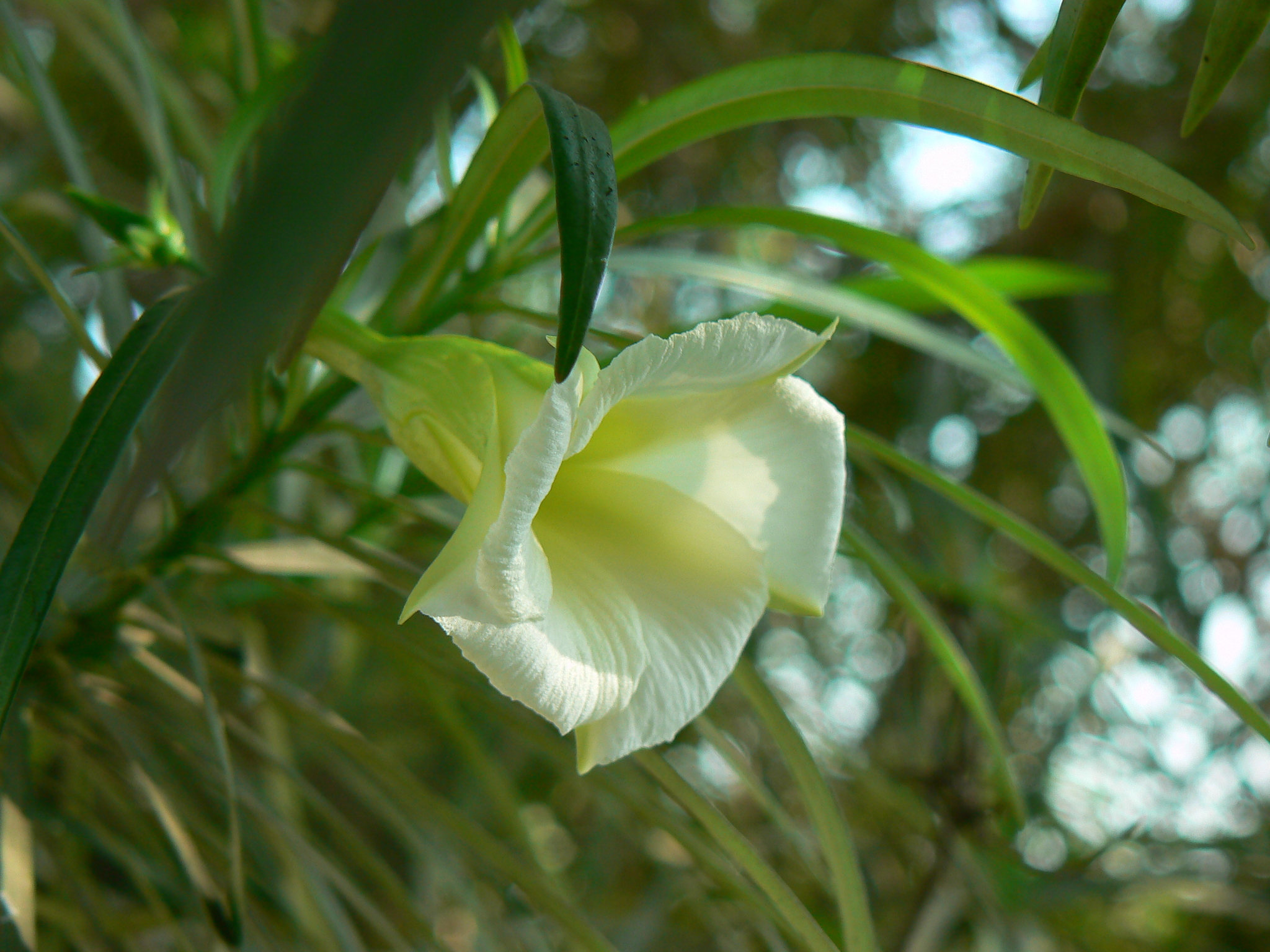
kas-kuh-BEL-uh -- Latinized form of Cascabel, a Spanish word meaning rattle ... Dave's Botanary
thev-VET-ee-uh -- named for Andre Thevet, 16th century French monk and plant collector ... Dave's Botanary
commonly known as: lucky nut, Mexican oleander, yellow oleander • Assamese: গছ-কৰবী gos-korobi, হালধীয়া কৰবী halodhia korobi, কনোৰ konor, কনৌৰ konour, কনৰু onoru • Bawm: khum-ba-rang-zah • Bengali: কলকে ফুল kolke phul • Dogri: पीला गनीहरा peela ganeehra, ज़र्द गंडीला zard gandeela • Garo: ceiling bol • Gujarati: પીળી કરેણ pili karen, પીરી કરેણ piri karen • Haryanvi: पीली कनेर peeli kaner • Hindi: पीली कनेर peeli kaner • Kachchhi: પીરી કરેણ piri karen • Kannada: ಕಾಡು ಕಾಸಿಕಣಿಗಲು kaadu kaasikanigalu, ಕರವೀರ karaveera • Konkani: बिटीं biti, हळदुवी halduvi, कण्यां kanya • Malayalam: മഞ്ഞ അരളി manja arali • Manipuri: ꯎꯇꯣꯡꯂꯩ utonglei • Marathi: बिट्टी bitti, पिवळा कण्हेर pivala kanher • Nepali: पहेँलो करवीर pahenlo karaveer • Odia: କନିଅର kaniara • Pahari: पीली कनेर peeli kaner • Punjabi: ਪੀਲੀ ਕਨੇਰ pili kaner • Rajasthani: पीळी कणेर pili kaner • Rangpuri: কালকে kalke • Santali: ᱵᱮᱨᱮᱧᱡᱳ berenjo • Sindhi: زنگي zangi • Tamil: சீமையலரி cimaiyalari, மஞ்சளலரி manjalalari, பொன்னலரி ponnalari • Telugu: పచ్చ గన్నేరు pachha ganneru, పసుపు గొట్టాల గన్నేరు pasupu gottala ganneru, సువర్ణ గన్నేరు suvarna ganneru • Tulu: ಕರವೀರೊ karaveero
known for / parts made use of: flowers (worship); the whole shrub (natural fencing, greenery); seeds & leaves (natural insecticide); bark & leaves (strictly external used traditional medicine) ... compiled from the web.
botanical names: Cascabela thevetia (L.) Lippold ... homotypic synonyms: Thevetia neriifolia Juss. ex A.DC. ... heterotypic synonyms: Thevetia peruviana (Pers.) K.Schum. ... and more at POWO, retrieved August 07, 2026
known for / parts made use of: flowers (worship); the whole shrub (natural fencing, greenery); seeds & leaves (natural insecticide); bark & leaves (strictly external used traditional medicine) ... compiled from the web.
Bibliography / etymology / notes
Links listed as references in the notes below, may not remain valid permanently. Portals / websites have a tendency to re-organize / revise their content, leading to change in URLs of pages in their site. Some sites may even close down at their own will. The bits about the languages of India mentioned below are merely some bare facts gathered from the internet; just enough to satisfy curiosity about "where" could the listed names be best prevalent in India. All English transliterated names to be taken sensu amplo.
~~~~~ ENGLISH ~~~~~
written and spoken widely, in most parts of India
lucky nut, Mexican oleander, yellow oleander
- Flowers of India ... (accessed: August 07, 2026)
- Lucky Nut — the unique name stems primarily from the unusual physical appearance of the inner stone. When the fleshy outer skin of the fruit rots away, it leaves behind a smooth, hard, woody nut that is roughly triangular and compressed into distinct ridges. In global folk folklore, people frequently noted that its distinct geometric shape bears an uncanny resemblance to a traditional fortune cookie. In local Caribbean folk traditions, it became a highly popular practice to dry out these smooth woody nuts and carry them inside a purse, wallet, or pocket as a personal talisman or good luck piece [↗]. This name is not popular or widely used among the general public in India, despite its presence on the internet. The overwhelming majority of urban Indians, horticulturists, and school textbooks use the direct descriptive name "Yellow Oleander". It merely acts as an academic tag. ... compiled from the web.
- "Mexican oleander" — the plant is an introduced exotic native to the Neotropics (Mexico and Central America). The name preserves the overarching "Oleander" botanical lookalike theme that connects almost all Indian languages. ... compiled from the web.
- The English common name "Yellow Oleander" is an example of reverse-naming (or calque-translation)! Early European colonizers and English botanists arriving in India borrowed the naming logic directly from indigenous Indian folk taxonomy and translated it back into English. ... compiled from the web.
~~~~~ ASSAMESE ~~~~~
written in: Assamese (অসমীয়া) ... spoken in: Assam, Arunachal Pradesh, Meghalaya
গছ-কৰবী gos-korobi, কনোৰ konor, কনৌৰ konour, কনৰু onoru
- XOBDO - Your gateway to multilingual knowledge and resources ... (accessed: August 08, 2026)
- Gos-Korobi (গছ-কৰবী) — this translates literally to "Tree Oleander". In Assamese, Korobi (কৰবী) is the traditional name for the native, smaller Nerium oleander. Because Cascabela thevetia grows much taller, developing a robust, woody, tree-like branching habit compared to the native pink oleander bushes, locals prefixed Gos (গছ) meaning "Tree" to distinguish it. ... compiled from the web.
- Konor (কনোৰ) / Konour (কনৌৰ) / Onoru (কনৰু): These variations represent clear examples of regional phonetic drifting. They are localized Assamese corruptions of the classical Sanskrit root Karavira (करवीर) and the Hindi cognate Kaner (कनेर). The shifting vowels across these variants showcase the oral evolution of the name as it integrated into local village dialects. ... compiled from the web.
হালধীয়া কৰবী halodhia korobi
- Deb, Chitta & Sharma, Ibeeka & Jamir, Narola. (2023). Ethno-medicinal anti-diabetics plants of Northeast India: A review. Journal of Pharmacognosy and Phytochemistry. 12. 86-92. 10.22271/phyto.2023.v12.i3b.14668. ... (downloaded: Nov 20, 2024)
- Halodhiya (হালধীয়া) — the standard Assamese word for the color Yellow. It is derived from Halodhi (হালধি), the native word for turmeric; Korobi (কৰবী) — The traditional Assamese term for the native Oleander (Nerium oleander). Translates to "Yellow Oleander". ... compiled from the web.
~~~~~ BAWM ~~~~~
written in: Latin ... spoken by: Bawm people ... spoken in: Mizoram, Tripura, Assam ... other names for this language: Bawm Zo, Banjogi
khum-ba-rang-zah
- List of Ethno-medicinal plants in Mizoram state with uses - Ministry of Ayush ... (downloaded: Feb 9, 2022)
~~~~~ BENGALI ~~~~~
written in: Bengali (বাংলা) ... spoken in: West Bengal, Assam, Jharkhand, Tripura, Andaman & Nicobar Islands
কলকে ফুল kolke phul
- উইকিপিডিয়া - একটি মুক্ত বিশ্বকোষ ... Wikipedia - The Free Encyclopedia ... (accessed: August 07, 2026)
- for Thevetia peruviana (Pers.) K.Schum. ... Mukherjee, Sobhan & Mitra, Sunit. (2009). Some abortifacient plants used by the tribal people of West Bengal. - Explorer: Research Paper, Natural Product Radiance, Vol. 8(2), 2009, pp.167-171 ... (downloaded: Feb 9, 2022)
- কলকে (Kolke) refers to the traditional, funnel-shaped clay bowl placed at the very top of a Hookah (traditional water smoking pipe) to hold the tobacco and burning charcoal. Because the flower of Cascabela thevetia is deeply tubular and flares open out abruptly into a perfect funnel shape, rural Bengalis immediately noticed it looked exactly like an upside-down hookah bowl. Thus "Kolke Phul" (Hookah-bowl Flower). ... compiled from the web.
~~~~~ DOGRI ~~~~~
written in: Devanagari (डोगरी) ... spoken in: Jammu & Kashmir ... spoken by the Dogras
पीला गनीहरा peela ganeehra, ज़र्द गंडीला zard gandeela
- Many thanks to OM Prakash Vidyarthi for help with these names ... facebook
- Ganeehra (गनीहरा) is the traditional vernacular name for the native Oleander (Nerium oleander). The prefix Peela (पीला) means the colour yellow - thus translates to "Yellow Oleander". ... compiled from the web.
- Zard (ज़र्द) — this is a Persian loan-word heavily integrated into Dogri, Punjabi, and Urdu, meaning Yellow or pale-gold; Gandeela (गंडीला) — this is an adjective derived from the core North Indian and Dogri noun Ganth (गांठ) or Gand (गंड), which means a knot, a joint, a bulb, or a swollen node. In Dogri folk taxonomy, a plant that displays prominent jointed or knot-like segmentations is labeled Gandeela (the knotted one). Cascabela thevetia features highly distinct, thickened, and swollen circular rings (nodes) at the point where the narrow leaves drop off the branches. These look like a succession of heavy knots or joints along the green wood. Literal translation of the name: "Yellow-Knotted Oleander". ... compiled from the web.
~~~~~ GARO ~~~~~
written in: Roman, Bengali-Assamese, A-Chik Tok'birim ... spoken in: Meghalaya, Assam
ceiling bol
- for Thevetia peruviana (Pers.) K.Schum. ... De, L.. (2019). MEDICINAL AND AROMATIC PLANTS OF NORTH EAST INDIA. International Journal of Development Research. 6. 10104- 10114. ... (downloaded: Feb 2, 2025)
- for Thevetia peruviana (Pers.) K.Schum. ... Sharma, Madhubala & L., Sharma & N., Marak. (2014). Indigenous uses of medicinal plant in North Garo Hills, Meghalaya, NE India. Research Journal of Recent Sciences. 3. 137-146. ... (downloaded: August 09, 2026)
~~~~~ GUJARATI ~~~~~
written in: Gujarati (ગુજરાતી) ... spoken in: Gujarat, Dadra & Nagar Haveli, Daman & Diu
પીળી કરેણ pili karen
- for Thevetia peruviana (Pers.) K.Schum. ... વનસ્પતીઓ ના ગુજરાતી તથા બોટનીકલ નામ ની યાદી :: સંકલન કર્તા વૈધ શ્રી કે,જે,ઝાલા ... (downloaded: 19 Jan 2026)
- for Thevetia peruviana (Pers.) K.Schum. ... Biological Diversity of Gujarat - published by Gujarat Ecology Commission ... (downloaded: Dec 16, 2020)
- for Thevetia neriifolia Juss. ex A.DC. ... Bimal S Desai - Floristic Diversity and Ethnobotany of Chhota Udepur Forest Division :: Chapter 4 :: Shodhganga - a reservoir of Indian theses @ INFLIBNET
- for Thevetia peruviana (Pers.) K.Schum. ... Solanki, Hitesh & Gamit, Binang & Maurya, Rupesh & Qureshimatva, Umerfaruq. (2015). CHECK LIST OF FLOWERING PLANTS IN TAPI DISTRICT, GUJARAT, INDIA. International Journal of Advanced Research. Volume 3. 1104 - 1123. ... (downloaded: Feb 9, 2022)
- Patel, Mayur & Punjani, Bhasker. (2021). A study of angiosperm diversity in Bayad taluka of Aravalli district, Gujarat. - International Journal of Botany. 6. 709-718. ... (downloaded: Sep 15, 2023)
પીરી કરેણ piri karen
- for Thevetia neriifolia Juss. ex A.DC. ... Bimal S Desai - Floristic Diversity and Ethnobotany of Chhota Udepur Forest Division :: Chapter 4 :: Shodhganga - a reservoir of Indian theses @ INFLIBNET
- for Thevetia peruviana (Pers.) K.Schum. ... S Rajendra Kumar, S Kalavathy (2010) - Floristic status and its conservation in the forests of the north Gujarat region (NGR) Gujarat, India :: Chapter 4 :: Shodhganga :: a reservoir of Indian theses @ INFLIBNET
FLIP OF THE SYLLABLE or SLIP OF THE TONGUE
The variants Pili Karen (પીળી કરેણ) and Piri Karen (પીરી કરેણ) alongside the expected Kaner (કણેર) make perfect linguistic sense when analyzed through the lens of historical sound shifts. The swapping of the middle and final consonants between Ka-ne-r and Ka-re-n is another classic example of metathesis (or Varna-Viparyaya in traditional Indian grammar). Both words descend from the ancient Sanskrit root Karavira (करवीर). As the word traveled orally through the western regions of India, the Prakrit and Apabhramsha dialects split the sound into two pathways: One pathway retained the 'n' sound in the middle, leading to the Hindi/Gujarati Kaner (કણેર); the other pathway flipped the syllables, pulling the 'r' forward and pushing the 'n' to the end, resulting in the highly popular Gujarati variant Karen (કરેણ). ... compiled from the web.
The morphing of the word for yellow from Pili (પીળી) to Piri (પીરી) is a famous phonetic shift known in historical linguistics as Rhotacism (specifically, the liquid alternation between the 'L' sound and the 'R' sound). ... compiled from the web.
~~~~~ HARYANVI ~~~~~
written in: Devanagari (हरियाणवी or हरयाणवी) ... spoken in: Haryana, Delhi
पीली कनेर peeli kaner (or पीला कनेर peela kaner)
- for Thevetia neriifolia Juss. ex A.DC. ... Haryana Forest Flora - A Comprehensive Database of Ligneous Plants of Haryana (India) ... (accessed: August 09, 2026)
- for Thevetia peruviana (Pers.) K.Schum. ... Department of Bio Sciences, Maharshi Dayanand University (2002) - Medicinal plants of some districts of Haryana an ethnobotanical survey :: Chapter 4 - Shodhganga :: a reservoir of Indian theses @ INFLIBNET ... (downloaded: Feb 9, 2022)
~~~~~ HINDI ~~~~~
written in: Devanagari (हिन्दी) ... spoken in: Delhi, Uttar Pradesh, Bihar, Chhattisgarh, Haryana, Jharkhand, Madhya Pradesh, Rajasthan, Uttarakhand
पीली कनेर peeli kaner
- विकिपीडिया - एक मुक्त ज्ञानकोश ... Wikipedia - The Free Encyclopedia ... (accessed: August 07, 2026)
- पीली (Peeli) - meaning yellow-coloured; कनेर (Kaner) - the Hindi term for the native Oleander (Nerium oleander). ... compiled from the web.
~~~~~ KACHCHHI ~~~~~
written in: Gujarati (કચ્છી), Sindhi (ڪڇّي) ... spoken in: Kutch region of Gujarat
પીરી કરેણ piri karen
- Patel, Yatin & Patel, Rohitkumar & Pankaj, Joshi & Dabgar, Yogesh. (2011). Study of the Angiospermic flora of Kachchh district, Gujarat, India. Life Sciences Leaflets. 19. 739-768. ... (downloaded: Feb 9, 2022)
~~~~~ KANNADA ~~~~~
written in: Kannada (ಕನ್ನಡ) ... spoken in: Karnataka
ಕಾಡು ಕಾಸಿಕಣಿಗಲು kaadu kaasikanigalu
- for Thevetia peruviana (Pers.) K.Schum. ...S G Narsimhachar - Latin and Kannada names of indigenous and medicinal plants of Mysore - Mandayam Digital Library ... (downloaded: Nov 27, 2020)
- for Thevetia peruviana (Pers.) K.Schum. ...Subrahmanya, Prasad K - Exploration and elucidation of traditional medicinal plants of erstwhile Tulunadu and surrounding area of Kerala and Karnataka :: Chapter 4 :: Shodhganga - a reservoir of Indian theses @ INFLIBNET
- for Thevetia peruviana (Pers.) K.Schum. ...ಪದಕಣಜ - ಕರ್ನಾಟಕ ಸರ್ಕಾರದ ಅಧಿಕೃತ ಜಾಲತಾಣ ... Padakanaja - Official website of Government of Karnataka
- ವಿಕಿಕೋಟ್ - ಒಂದು ಸ್ವತಂತ್ರ ವಿಶ್ವಕೋಶ ... Wikipedia - The Free Encyclopedia ... (accessed: August 08, 2026)
- The prefix Kaasi (ಕಾಸಿ) refers directly to Kaashi (Varanasi/Benaras), the ancient holy city in Northern India deeply associated with Lord Shiva, while kanigalu / kanigilu / kanagilu / kanigile (ಕಣಿಗಲು / ಕಣಿಗಳು / ಕಣಿಗಿಲು / ಕಣಗಿಲು / ಕಣಿಗಿಲೆ) are regional variations of the Kannada word for the native Oleander (Nerium oleander). Conceptually, the name translates to 'The Oleander of Kaashi'. Because Kaashi is historically revered as the ultimate spiritual heartland of Lord Shiva, local devotees in the Tulunadu region (spanning the coastal Karnataka and Kerala border) traditionally prefix 'Kaasi' to the names of specific flora whose blossoms are heavily favoured in Shaivite ritual worship. ... compiled from the web.
- While the prefix Kaadu (ಕಾಡು) typically signifies 'wild', 'untended', or 'forest-dwelling' — attributes that may initially seem contradictory for an introduced, ornamental species — it serves a distinct purpose in folk taxonomy. In this context, 'Kaadu' functions as a linguistic marker indicating that a plant is highly toxic, inedible, or structurally coarse. Furthermore, it denotes a strong tendency to escape cultivation and naturalize independently, characteristics that accurately describe the ecological behavior of Cascabela thevetia across the Indian landscape. ... compiled from the web.
ಕರವೀರ karaveera
- for Thevetia peruviana (Pers.) K.Schum. ... Subrahmanya, Prasad K - Exploration and elucidation of traditional medicinal plants of erstwhile Tulunadu and surrounding area of Kerala and Karnataka :: Chapter 4 :: Shodhganga - a reservoir of Indian theses @ INFLIBNET
- ವಿಕಿಕೋಟ್ - ಒಂದು ಸ್ವತಂತ್ರ ವಿಶ್ವಕೋಶ ... Wikipedia - The Free Encyclopedia ... (accessed: August 08, 2026)
FLIP OF THE SYLLABLE or SLIP OF THE TONGUE
A close examination of historical Kannada botanical manuscripts reveals a peculiar phonetic pattern: the vernacular name for this species frequently morphs, shifting between variations such as kanigalu, kanigilu, kanagilu and kanigile. Far from being typographical errors, these variations are prime examples of a linguistic phenomenon known as metathesis (or Varna-Viparyaya in traditional Indian grammatical scholarship). This process is essentially a natural, intergenerational 'flip of the syllable' or a 'slip of the tongue'. When plant names travel through rural communities via oral tradition rather than standardized print dictionaries, the consonants and vowels naturally rearrange over time into configurations that flow more rhythmically within a specific local dialect. ... compiled from the web.
~~~~~ KONKANI ~~~~~
written in: Devanagari (कोंकणी) / Kannada (ಕೊಂಕಣಿ) / Malayalam (കൊങ്കണി) / Perso-Arabic (کونکنی) / Romi (Konknni) ... spoken in: Goa, Karnataka, Maharashtra, Kerala, Gujarat
बिटीं biti, हळदुवी halduvi
- for Thevetia peruviana (Pers.) K.Schum. ... V D Vartak (1966) - Enumeration of plants from Gomantak India with a note on botanical excursions to the Castlerock area :: Chapter 5 :: Shodhganga :: a reservoir of Indian theses @ INFLIBNET
कण्यां kanya
- Glimpses of Biodiversity in Panaji - Goa State Biodiversity Board | Corporation of City of Panaji
~~~~~ MALAYALAM ~~~~~
written in: Malayalam (മലയാളം) ... spoken in: Kerala, Lakshadweep
മഞ്ഞ അരളി manja arali (or മഞ്ഞരളി manjarali)
- for Thevetia peruviana (Pers.) K.Schum. ...AnilKumar N., Salim P.M., Balakrishnan V., Sivan V.V. (2001) - Medicinal Plants known from Wayanad - M S Swaminathan Research Foundation ... (downloaded: July 6, 2023)
- for Thevetia peruviana (Pers.) K.Schum. ...K A Anil Kumar and P S Udayan - Plant diversity of the Attappady hills, Western Ghats :: Chapter 4 :: Shodhganga - a reservoir of Indian theses @ INFLIBNET
- വിക്കിപീഡിയ - സ്വതന്ത്രസർവ്വവിജ്ഞാനകോശം ... Wikipedia - The Free Encyclopedia ... (accessed: August 07, 2026)
- മഞ്ഞ (Manja) = the yellow colour; അരളി (Arali) = native Malayalam term for the native Oleander (Nerium oleander). ... compiled from the web.
~~~~~ MANIPURI ~~~~~
written in: Meiteilon (ꯃꯩꯇꯩꯂꯣꯟ), Bengali-Assamese ... spoken in: Manipur ... other names for this language: Meetei
ꯎꯇꯣꯡꯂꯩ utonglei
- Flowers of India ... (accessed: August 07, 2026)
- Sharma, H. Surmangol. Learners' Manipuri-English dictionary. Imphal : Sangam Book Store, 2006.
- Hanjabam, Manoranjan. (2005). Vegetable dyes used by the Meitei Community of Manipur. Indian Journal of Traditional Knowledge. 4. 39-46. ... (downloaded: July 22, 2024)
- for Thevetia peruviana (Pers.) K.Schum. ... Ningombam, D. & Devi, S. & Singh, Potsangbam & Pinokiyo, Athokpam & Thongam, Biseshwori. (2014). Documentation and Assessment on Knowledge of EthnoMedicinal Practitioners: A Case Study on Local Meetei Healers of Manipur. IOSR Journal of Pharmacy and Biological Sciences. 9. 53-70. 10.9790/3008-09115370. ... (downloaded: Nov 20, 2024)
- for Thevetia neriifolia Juss. ex A.DC. ... Singh S. Sukumar. The Economic Plants of Manipur and Their Uses, Manipur, 2006, 2009.
~~~~~ MARATHI ~~~~~
written in: Devanagari (मराठी) ... spoken in: Maharashtra, Karnataka
बिट्टी bitti
- for Thevetia peruviana (Pers.) K.Schum. ... The Gazetteer Department - Maharashtra State ... महाराष्ट्रातील वनस्पतीशास्त्र आणि वनसंपदा ... (downloaded: Sep 5, 2020)
- TransLiteral Foundations - A Nonprofit Public Service Initiative ... (accessed: August 08, 2026)
- बिट्टी (Bitti) or बिट्की (Bitki) refer to a small, hard, rounded object — specifically the small stone tokens, heavy seeds, or clay balls used by children in traditional street games like Jhelgote (झेलगोटे), Sagargote (सागरगोटे), or localized variations of marbles. The naming convention ignores the plant's bright yellow flowers and focuses entirely on the unique shape and utility of its seeds. The unusual, hard, angular, and somewhat triangular-to-rounded inner nut (kernel) encased within its fruit. For generations across villages in Maharashtra, children gathered these fallen toxic nuts to use as makeshift, unbreakable marbles or throwing tokens for street games. Because the nut itself functioned perfectly as a bitti (playing marble), rural communities naturally transferred the name of the game object to the entire tree, calling it the Bitti plant. ... compiled from the web.
पिवळा कण्हेर pivala kanher (or पिवळी कण्हेर pivali kanher)
- for Thevetia neriifolia Juss. ex A.DC. ... Journal of the Bombay Natural History Society - Volume 3 issue 1 ... (accessed: August 08, 2026)
- for Thevetia peruviana (Pers.) K.Schum. ... The Gazetteer Department - Maharashtra State ... महाराष्ट्रातील वनस्पतीशास्त्र आणि वनसंपदा ... (downloaded: Sep 5, 2020)
~~~~~ NEPALI ~~~~~
written in: Devanagari (नेपाली) ... spoken in: Nepal, West Bengal, Assam, Sikkim, Himachal Pradesh, Uttarakhand, Jammu & Kashmir
पहेँलो करवीर pahenlo karaveer
- Many thanks to Saroj Kumar Kasaju for help with this name ... eFloraofIndia
- Pahenlo (पहेँलो) — the standard Nepali word for colour Yellow; Karavira (करवीर) — the direct, uncorrupted Sanskrit root for Oleander. ... compiled from the web.
~~~~~ ODIA ~~~~~
written in: Odia (ଓଡ଼ିଆ) ... spoken in: Odisha, Andaman & Nicobar Islands
କନିଅର kaniara (variants: କଣିଅର kaniara / କନିଆର kaniara / କଣିଅର kaniara / କନିଆରି kaniari / କଣିଆରି kaniari)
- for Thevetia peruviana (Pers.) K.Schum. ... Sudam Charan Sahu, Sabita Tudu, Namita Maharana, Sifan Priyadarshini. (2024). Assessment of plant diversity in Maharaja Sriram Chandra Bhanja Deo University Campus, Odisha, India. Sustainability and Biodiversity Conservation, 3(2), 1–25. ... (downloaded: July 21, 2026)
- Sethi, Jashabanta & Kumar, Sanjeet & Supriya Devi, Rajkumari & Mishra, Sweta & Marndi, Sugimani & Rout, Subhalakshmi & Jena, Nibedita. (2026). Floral Diversity of Rourkela Forest Division, Odisha. ... (downloaded: June 27, 2026)
- Das P K, Sahoo T, Panda P C. Forest trees of Odisha, India: An updated checklist. Plant Science Today. 2022; 9(4): 1021–1031. ... (downloaded: Aug 29, 2023)
- Kumar, Sanjeet & Supriya Devi, Rajkumari. (2020). Report on Floral Diversity of SAMBHAV, Nayagarh, Odisha, India. 10.13140/RG.2.2.21260.54402. ... (downloaded: July 4, 2023)
~~~~~ PAHARI (or PAHADI) ~~~~~
written in: Devanagari (पहाड़ी), Perso-Arabic (پہاڑی) ... variety of languages, dialects and language groups, spoken in Himachal Pradesh, Jammu and Kashmir, Uttarakhand
पीली कनेर peeli kaner
- for Thevetia neriifolia Juss. ex A.DC. ... Rawat, Megha & Vasistha, Harsh & Manhas, Rajesh & Negi, Mridula. (2013). FLORISTIC DIVERSITY OF THE KUNJAPURI SACRED GROVE, GARHWAL HIMALAYA, INDIA. Journal of the Bombay Natural History Society. 110. 57-64.
~~~~~ PUNJABI ~~~~~
written in: Gurmukhi (ਪੰਜਾਬੀ) ... spoken in: Punjab
ਪੀਲੀ ਕਨੇਰ pili kaner
- ਵਿਕੀਪੀਡੀਆ - ਇੱਕ ਆਜ਼ਾਦ ਵਿਸ਼ਵਕੋਸ਼ ... Wikipedia - The Free Encyclopedia ... (accessed: August 08, 2026)
~~~~~ RAJASTHANI ~~~~~
written in: Devanagari (राजस्थानी) ... spoken in: Rajasthan
पीळी कणेर pili kaner
- for Thevetia peruviana (Pers.) K.Schum. ... R. P. Kanther - DOMINANT FLORA OF PALI-DISTRICT, RAJASTHAN, INDIA J. Indian Bot. Soc., Vol. 100 (1&2) 2020:01-15 ... (downloaded: Jun 15, 2024)
- for Thevetia peruviana (Pers.) K.Schum. ... Manju Chaudhary and S.K. Shringi - Floristic Composition of Beer Jhunjhunu Conservation Reserve of Rajasthan, India - The Biobrio 4(1 & 2), 2017 ... (downloaded: Feb 9, 2022)
~~~~~ RANGPURI ~~~~~
written in: Bengali-Assamese (রংপুরী, কোচ-ৰাজবংশী, দেশী), Devanagari (रंगपुरी) ... spoken in: Bangladesh, north Bengal, lower Assam ... other names for this language: Anchalit, Bahe, Deshi, Koch-Rajbongshi
কালকে kalke
- for Thevetia peruviana (Pers.) K.Schum. ... Mukherjee, Sobhan & Mitra, Sunit. (2009). Some abortifacient plants used by the tribal people of West Bengal. - Explorer: Research Paper, Natural Product Radiance, Vol. 8(2), 2009, pp.167-171 ... (downloaded: Feb 9, 2022)
~~~~~ SANTALI ~~~~~
written in: Ol Chiki (ᱥᱟᱱᱛᱟᱲᱤ), Bengali (সাঁওতালী), Odia (ସାନ୍ତାଳୀ), Devanagari (सान्ताली), Roman ... spoken in: Jharkhand, West Bengal, Odisha
ᱵᱮᱨᱮᱧᱡᱳ berenjo
- for Thevetia neriifolia Juss. ex A.DC. ... A forest flora of Chota Nagpur including Gangpur and the Santal-Parganahs by Haines, Henry Haselfoot, 1867-1943
~~~~~ SINDHI ~~~~~
written in: Perso-Arabic (سِنڌِي), Gujarati (સિંધી), Devanagari (सिन्धी) ... spoken in: Gujarat, Maharashtra, Rajasthan
زنگي zangi
- وڪيپيڊيا - هِڪُ کُليل ڄاڻَ چِيڪلو ... Wikipedia - The Free Encyclopedia ... (accessed: August 08, 2026)
- In older literary and poetic usage across Persia and Sindh, زنگي (Zangi) was used to describe something deeply dark-skinned or obsidian black. While the trumpet blossoms are yellow, Cascabela thevetia produces large, fleshy fruits that shift from green to a stark, shiny, jet-black color. Early Sindhi local taxonomists bypassed the seasonal yellow flowers and named the entire plant Zangi after the persistent, defining characteristic of its pitch-black mature fruit and seeds. ... compiled from the web.
~~~~~ TAMIL ~~~~~
written in: Tamil (தமிழ்) ... spoken in: Tamil Nadu, Puducherry, Andaman & Nicobar Islands
சீமையலரி cimaiyalari, மஞ்சளலரி manjalalari, பொன்னலரி ponnalari
- for Thevetia neriifolia Juss. ex A.DC. ... University of Madras. Tamil lexicon. [Madras], University of Madras, 1924-1936.
- சீமையலரி cimaiyalari — In Tamil, the prefix Cimai (சீமை) historically refers to a foreign country, a distant land, or territories overseas (often associated with European or colonial introductions). Since true Oleander (Nerium) is called Alari (அலரி), the community prefixed Cimai to explicitly identify Cascabela thevetia as the introduced, foreign lookalike. ... compiled from the web.
- Manjalalari (மஞ்சளலரி / மஞ்சள் அலரி) — this translates directly to "Yellow Oleander". ... compiled from the web.
- Ponnalari (பொன்னலரி / பொன் அலரி) — this translates elegantly to "Golden Oleander". In Tamil, Pon (பொன்) means gold. Rather than using the standard word for yellow (Manjaḷ), this name elevates the plant's visual identity by comparing the bright, metallic, trumpet-shaped yellow blossoms to polished gold. ... compiled from the web.
- The English name mentioned in the Tamil Lexicon [↗] "Exile Oleander" (or simply "Exile Tree") is a genuine historical name for Cascabela thevetia. While it is no longer popular in mainstream modern English — having been largely replaced by "Yellow Oleander" or "Lucky Nut" — it is frequently documented in older colonial botanical literature across South and Southeast Asia. The name stems from the plant's history as an introduced, alien species brought over from the tropical Americas. Because it was uprooted from its native home and transplanted into "exile" across European tropical colonies in Asia and West Africa, early colonial botanists colloquially labeled it the "Exile Oleander" to distinguish this foreign newcomer from the native true oleander (Nerium oleander). ... compiled from the web.
~~~~~ TELUGU ~~~~~
written in: Telugu ( తెలుగు) ... spoken in: Andhra Pradesh, Telangana, Puducherry
పచ్చ గన్నేరు pachha ganneru, పసుపు గొట్టాల గన్నేరు pasupu gottala ganneru, సువర్ణ గన్నేరు suvarna ganneru
- Flora Andhrika - Plant Wealth of Andhra Pradesh, India ... (accessed: August 08, 2026)
- FRLHT's ENVIS Centre on Medicinal Plants ... (accessed: August 08, 2026)
- Ganneru (గన్నేరు) is the traditional name for the native Oleander (Nerium oleander), derived from the ancient Sanskrit root Karavira. The word Paccha (పచ్చ) serves a dual purpose in Telugu, denoting both green and yellow depending on the context (often used for yellow gold or yellow turmeric, paccha pasa-pu). Translates to "Yellow Oleander" or "Greenish-Yellow Oleander". ... compiled from the web.
- Pasupu (పసుపు) means turmeric-yellow. Gottam (గొట్టం / plural: గొట్టాలు) means a tube, pipe, or hollow cylinder. The local Telugu taxonomy uniquely calls out the deeply elongated, tubular pipe-shape of the Cascabela blossom before it flares open. Translates to "Yellow-Tube Oleander" or "Yellow-Pipe Oleander". ... compiled from the web.
- Suvarna (సువర్ణ) is a formal, Sanskritized term for pure gold. Rather than using the everyday word for yellow (Pasupu), this name elevates the plant's visual profile by highlighting the brilliant, metallic sheen of the blossoms. Translates to "Golden Oleander". ... compiled from the web.
~~~~~ TULU ~~~~~
written in: Tigalari (Tulu) was used for writing Vedic texts in Sanskrit, Kannada (ತುಳು), Malayalam (തുളു) ... spoken in: Karnataka, north Kerala
ಕರವೀರೊ karaveero
- for Thevetia peruviana (Pers.) K.Schum. ... Subrahmanya, Prasad K - Exploration and elucidation of traditional medicinal plants of erstwhile Tulunadu and surrounding area of Kerala and Karnataka :: Chapter 4 :: Shodhganga - a reservoir of Indian theses @ INFLIBNET
~~~~~ KNOWN DISTRIBUTION in INDIA ~~~~~
throughout (introduced)
- Hassler, Michael (1994 - 2026): World Plants. Synonymic Checklist and Distribution of the World Flora. Version 26.08; last update Aug. 2nd, 2026. Last accessed 07/08/2026 (dd/mm/yyyy).
- Historical and botanical records indicate that Cascabela thevetia was introduced into India sometime during the late 18th century to early 19th century, primarily brought over by Christian missionaries, European botanical explorers, Portuguese and Iberian traders. ... compiled from the web.
MUCH ADO ABOUT NOTHING
The inclusion of Sanskrit and Tibetan names for this species in modern online databases appears to be the result of a forced comparison rather than true historical use. Because this plant is commonly called 'Yellow Oleander', names belonging to native, red-flowered oleanders seem to have been broadly copied over to this yellow-flowered foreign species without much distinction.
Not every name from every language that exists on the web is included in this compilation. To ensure this page remains reliable and clean, names that appear obviously forced into synonymy have been intentionally left out. This blog focuses strictly on genuine everyday names used by regional communities across India.
~~~~~
Created on: 16:35 07-08-2026 ¦ Last updated: 16:33 10-08-2026 (DD-MM-YYYY)
~~~~~
.


No comments:
Post a Comment